

By Justin Ray, founder of Narracomm
AI-generated music offers a mirage of emotion and feeling. The soulless models train on pre-existing, manmade music compositions, their harmony and structure. And then steals them, producing forgeries, counterfeits, phonies, and knockoffs for mass, unwashed consumption.
AI copies and original human compositions are already blending into one in the ears of casual listeners. Artificial intelligence simulates human music so convincingly that it is tough for many to figure out which is which. Only expert music listeners can distinguish the two.
Still, AI-generated music’s only true innovation is the elimination of humans from the music making process, padding already record corporate profits. Since the days of Woody Guthrie, musicians have always been a little too pesky for the suits, who now have the tools to extinguish the musician off the face of the earth. The margins of mocha-sipping executive stooges in skyscrapers balloon, all on the backs of the creative class.
Today’s artificial intelligence trains itself on human-composed pieces. Tomorrow, artificial intelligence will train itself on the AI-generated compositions of today. Humans would no longer be needed as the free labor for training models.
Over time, and with lightning speed, artificial intelligence learns cultural nuances and emotions, supplanting musicians entirely, leading to widespread dehumanization and cultural erasure.
Since most artificial intelligence models are trained on data from the West, the homogenization of global cultures accelerates. When SunoAI rips off Middle Eastern Maqamat music, it doesn’t bother with the microtones. It just uses the nearest note on the Western scales. Indian raja reduced to caricature. The death of genre.
AI is already releasing an avalanche of music prior art. Humans will one day have trouble formulating music they can copyright, since machines will have already done it. Tech titans will hold a monopoly on sound.
Not long ago, a person’s voice was a unique trait. Not anymore. Voices rendered fodder for the AI Gods, pirated in ways that make Sean Parker look like a microgreens farmer and Napster the local Farmer’s Market.

+Read more: "AI Stole My Client’s Song — Then Its Version Went Viral."
The Past Stolen
All this amounts to tech bros stealing the past itself. What Elton John called "committing theft, thievery on a high scale.”
And yet a resistance brews, standing nary a chance against a shoulder-to-shoulder $400 billion American technology industry and the $30 billion music industry. Sting told a BBC currently replacing its writers with AI:
“The building blocks of music belong to us, to human beings. That’s going to be a battle we all have to fight in the next couple of years: defending our human capital against AI.”
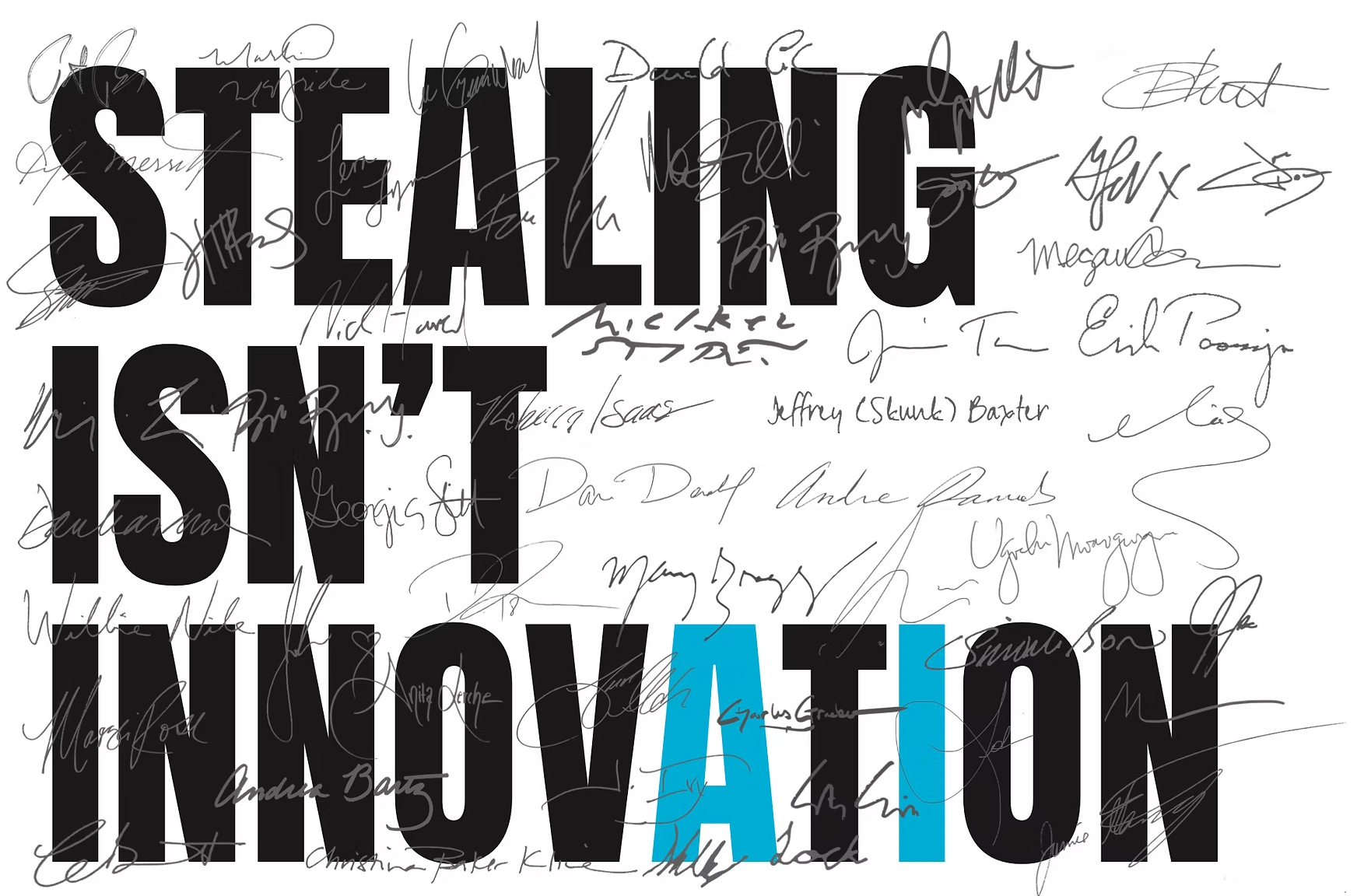
In addition, campaigns like “Stealing Isn’t Innovation” are backed by renowned musicians like Questlove, Cyndia Lauper, and R.E.M. Queen’s Brian May sees the future as “already forever changed” in a reality where AI models eat copyrighted music and excrete it out directly into our auricles.
“This theft has already been performed and is unstoppable, like so many incursions that the monstrously arrogant billionaire owners of AI and social media are making into our lives.”
It’s a creepy, disconcerting, and synthetic reality.
“It’s a weird kind of wanky, tech-bro nightmare future, and it seems this is what the tech industry does best,” said Radiohead’s Thom Yorke. “A devaluing of the rest of humanity, other than themselves, hidden behind tech.”
Hope Springs
But, it’s important to understand: AI-generated facsimiles of sound are not musical reality. They are musical simulations. They are one part of our emerging hyperreality, a state in which consciousness can no longer decipher simulation from reality, a concept most often associated with French sociologist Jean Baudrillard.
AI-generated music is a type of false reality with severe limitations, too. In The Creative Mind: Myths and Mechanisms, social psychologist Margaret A. Boden argues there are three varying forms of creativity. One, the one of which AI is capable, involves piecing together unfamiliar combinations of familiar ideas. The others, the ones beyond artificial intelligence, involve exploration and transformation of the conceptual spaces that exist in peoples' minds.
Conceptual spaces are “structured styles of thought” borne of a culture. These include musical styles, poetics, and more. They demarcate the implicit boundaries of thoughts within a cultural space, where creative exploration and transformation happens.
New ideas radically broaden the culture. But, they come not from an individual mind. They instead come from what’s come before in one’s culture or are inspired by other cultures. Boden said:
“The deepest cases of creativity involve someone’s thinking something which, with respect to the conceptual spaces in their minds, they couldn’t have thought before.”
AI models fall short of explorational and transformational creativity. As well, in studies, people say they prefer works they believe were made by humans over those they believe were AI-generated. They say human compositions hold beauty and profundity. Musical works composed by humans take more effort, intention, and emotional investment. They are drawn to that.
People also identify with the musician or musicians behind a song, and stop connecting with a piece when they believe it was jerry-built by a machine. Hope for music, then, lies in the need for human connection.
If we don’t wish for AI to replace jam sessions, and prefer fellow humans conveying heartbreak over machines, music lovers must demand streaming platforms properly label AI-generated music by any means necessary.
Justin Ray is an indie musician and founder of Narracomm, a public relations firm serving music and the technology industries.