The voice in your earphones when listening to a podcast, used to be a voice you could put your trust in. In fact that's most of why the medium grew so much and so fast in it's initial iteration.
But the assumption that there's a real human voice behind the microphone now is starting to get shakier.
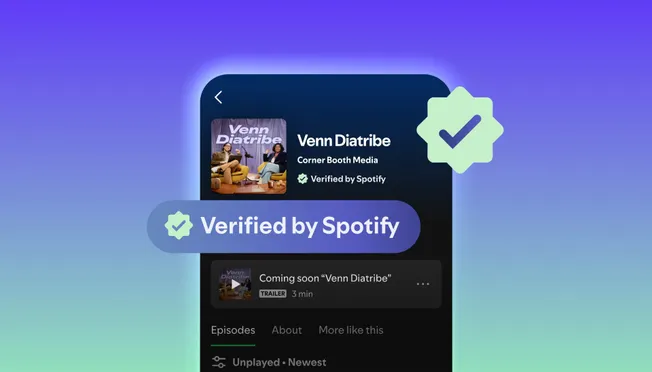
This week, Spotify announced it is expanding its “Verified by Spotify” system to podcasts, introducing official verification badges for shows as part of what the company describes as a broader push toward authenticity and trust in the AI era.
The badge is a light green checkmark paired with “Verified by Spotify” that will begin appearing on select podcast pages and in search results starting today, with a broader rollout planned over the coming months.
According to Spotify, verified podcast shows will be reviewed against criteria that include sustained audience engagement, compliance with platform rules, and safeguards against fraudulent or bot-driven listening activity.
But it's not exactly the badge that takes center stage with this announcement, it's the unusually direct language around AI impersonation coming from Spotify.
The company says it will remove podcast content that imitates another creator or host’s likeness without permission, including through AI voice cloning technologies. While Spotify notes that its impersonation policies already existed, this is one of the clearest public signals yet that major audio platforms are preparing for a future where synthetic voices become increasingly difficult to distinguish from real ones.

+Read more: "What Is Multi-Dimensionality? In Music, It May Be Coming Back."
Podcasting Has Entered Its Authenticity Era
Podcasting exploded because it gave audiences a means to develop above-average levels of "intimacy" with creators. Audio is extremely powerful in this way. Listeners spend hours with hosts every week — often more time than they spend with musicians, actors, or influencers combined, especially in paid, ticketed settings. That's a full on "relationship."
That intimacy is the product. Which means trust is the infrastructure underneath the entire medium.
Spotify’s verification move suggests the platform understands that AI-generated audio doesn’t just create moderation problems; it creates identity problems. If anyone can generate a convincing imitation of a creator’s voice, listeners need clearer signals about what is official, authorized, and real.
The music industry is already wrestling publicly with AI clones and synthetic artists. Podcasting may be next.
The obvious beneficiaries here are large podcast brands and established creators. But if you're an independent podcaster, this can definitely help you prove your ability to create legitimate, and intimate, fan-fueled relationships.
And unlike older social-media-era verification systems, Spotify appears to be tying eligibility partly to consistency and audience behavior, not simply notoriety. It may be about who can sustain genuine listener relationships in a world where artificial voices become abundant.
+Read more: "How to Get Your Tour Dates to Appear on Your Spotify Page"