

Live Nation and Ticketmaster are fighting legal battles on multiple fronts.
The three most consequential are a federal antitrust monopoly case brought by state attorneys general, a Department of Justice settlement working its way through Tunney Act review, and a separate FTC consumer-protection lawsuit.
Here is here each case stands and what's coming next.
The DOJ Antitrust Case / Tunney Act Review
Status: Settled with DOJ — approval process underway
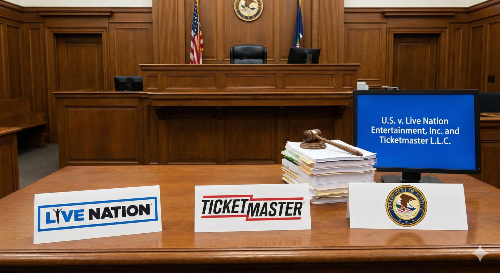
The Department of Justice (DOJ) originally sued Live Nation in May 2024, joined by a coalition of state attorneys general, alleging the company illegally monopolized virtually every aspect of the live entertainment business. The trial began March 2, 2026, in Manhattan before U.S. District Judge Arun Subramanian. But in a move that surprised even the court, the DOJ and Live Nation reached a tentative settlement just a week in.
Under the deal, Live Nation agreed to:
- Create a $280 million fund to address state damages claims
- End exclusive booking agreements with 13 amphitheaters
- Cap Ticketmaster service fees at 15% of face value at Live Nation venues
- Open parts of its platform to competing ticketing companies
- Accept an eight-year extension of its existing consent decree
- An “Artist Transparency” clause requires Live Nation to provide artists, upon request, information about who purchased tickets to their shows
The DOJ's settlement carries no admission of wrongdoing by Live Nation.
For the deal to take effect, it must pass a Tunney Act fairness review — a court-supervised public comment process. At a May 7 conference, Judge Subramanian indicated the DOJ should proceed, with the government planning to file its Proposed Final Judgment and related materials by late May 2026. After a mandatory 60-day public comment period, the DOJ expects to file a motion for entry of final judgment in early or mid-September 2026, with Subramanian signaling he could have a decision by mid-September or October.
Key Dates:
- Late May 2026: DOJ to file Proposed Final Judgment and Tunney Act materials
- Early–mid September 2026: DOJ expected to make a motion for entry of final judgment
- September–October 2026: Expected Tunney Act ruling by Judge Subramanian

The State AGs Antitrust Trial
Status: Liability found by jury with remedies phase ahead
The bigger legal story right now belongs to the bipartisan coalition of state attorneys general who rejected the DOJ settlement and pushed the case through a full jury trial.
After the DOJ settled, 33 states and the District of Columbia pressed on independently. Following nearly five weeks of testimony a nine-person Manhattan jury delivered a unanimous liability verdict on April 15, 2026.
The jury found that Live Nation and Ticketmaster illegally monopolized both the live event ticketing market and the large amphitheater market. The jury also found Ticketmaster had overcharged consumers by an average of $1.72 per ticket.
Now the case moves to a separate bench trial before Judge Subramanian to determine remedies. That process is expected to be substantial: the states must file a preliminary description of their requested remedies by May 21, after which the judge will set a formal schedule.
The judge indicated the remedies hearing likely won't arrive until as early as February 2027. The next scheduled status conference is July 30, 2026.
What do the states want?
Potentially everything: treble damages, civil penalties, and structural relief including a possible forced breakup of Live Nation and Ticketmaster. Both Republican and Democratic AGs have signaled they'll push hard. Republican Texas AG Ken Paxton pledged to "pursue every possible remedy under the law," and Democratic Colorado AG Phil Weiser (D) said concertgoers "deserved a fair trial and a fair deal."
The National Independent Venue Association (NIVA) and the National Independent Talent Organization (NITO) are lobbying state AGs in an effort to influence the remedies phase.
For its part, Live Nation has accrued a $450 million legal reserve - its "best estimate of the ultimate loss" from the states' suit - disclosed in its Q1 2026 earnings call, in which the company also reported revenue up 12% to $3.8 billion for the quarter.
Live Nation predicts that once remedies and any appeals play out, the final outcome won't look materially different from the DOJ settlement. But legal analysts at Crowell & Moring are more cautious, noting that with pending Rule 50 and 59 post-trial motions, the Tunney Act review, a full remedies phase, and near-certain appeals, final resolution is unlikely before 2028.
"Federal clearance or a negotiated DOJ consent decree does not insulate a company from state-level exposure," wrote the analysts, "and the potential remedy here, a full structural breakup, goes well beyond what the DOJ’s own settlement required."
Key Dates:
- May 21, 2026 — States must file preliminary description of remedies sought
- July 30, 2026 — Next status conference before Judge Subramanian
- February 2027 (earliest) — Remedies bench trial expected to begin
The FTC / BOTS Act Lawsuit
Status: Motion to dismiss pending — legal sparring intensifies
On September 18, 2025, the Federal Trade Commission (FTC) joined by seven states filed a separate lawsuit against Live Nation and Ticketmaster in the U.S. District Court for the Central District of California. It targeted a different set of conduct: alleged coordination with ticket scalpers and deceptive pricing practices.
The FTC's complaint alleges that Ticketmaster tacitly coordinated with brokers who used thousands of fake accounts and proxy IP addresses to harvest millions of tickets in bulk, then resold those tickets at massive markups on Ticketmaster's own secondary platform.
A senior Ticketmaster executive reportedly admitted in an internal email — copied to Live Nation leadership — that the companies "turn a blind eye as a matter of policy" to brokers violating posted ticket limits. The FTC further alleges that just five brokers controlled 6,345 Ticketmaster accounts and held 246,407 concert tickets across 2,594 events.
The FTC also alleges deceptive pricing: mandatory fees running as high as 44% of the ticket price, hidden until late in checkout, totaling $16.4 billion from 2019–2024. The complaint invokes both the FTC Rule on Unfair or Deceptive Fees and the Better Online Ticket Sales (BOTS) Act.
In January 2026, Live Nation moved to dismiss, calling the lawsuit "an egregious instance of agency overreach." That motion is still pending.
A related development came on April 29 when a Maryland court rejected scalper Key Investment Group's motion to dismiss a separate FTC BOTS Act case.
The FTC quickly flagged the ruling to the Live Nation court on April 30 as supporting its own position.
Live Nation fired back, arguing the two lawsuits aren't comparable: the KIG case involved subparagraph A of the BOTS Act (circumventing technological controls), while the Live Nation case was brought under subparagraph B (resale of tickets allegedly obtained through circumvention) — a distinction Live Nation argues is legally significant. The company also noted that the KIG decision repeatedly described Ticketmaster as "the victim" of scalpers — the opposite framing from the FTC's theory in the Live Nation case.
Key Date:
- TBD —A hearing on Live Nation's motion to dismiss the FTC BOTS Act complaint has not been publicly announced.
Hypebot's Bottom Line
Live Nation is simultaneously managing a DOJ settlement in Tunney Act review, a state-led antitrust remedies process that could ultimately seek a corporate breakup, and a pending FTC consumer-protection case targeting its ticketing fee and resale practices.
The remedies fight with the states is the most consequential proceeding — and the one most likely to determine whether Ticketmaster's 15-year reign as the dominant U.S. concert ticketer continues in its current form.
Despite it all, Live Nation shares closed at roughly $163 on Friday March 8, up more than 21% from a year ago as the concert giant leans into international expansion - notably outside the purview of U.S. regulators.