

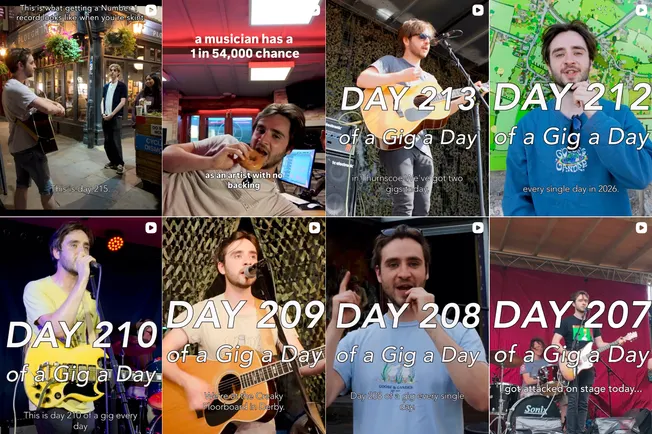
In an industry fixated on streams, followers and short-form virality, Isaac Neilson has chosen a much slower way to find an audience: meeting it in person.
The 26-year-old British indie-rock artist is attempting to perform live on every day of 2026. When The Guardian caught up with him, he was 231 consecutive days into the challenge, had visited more than 60 UK towns and cities and put nearly 20,000 miles on his Peugeot.
And in fact, because he sometimes performs more than once in a day, he expects to finish the year with more than 400 performances.
Neilson has driven an average of three hours a day, slept on friends’ sofas and watched the more than £30,000 he had saved fall toward a projected £3,000. It is an extraordinary feat of endurance. But it's not just a torturous gauntlet for a touring musician to put himself through, it's a test:
Does the old-fashioned path to music discovery still work?
+Read more: "Maroon 5 Played a Hedge-Fund Guy's Birthday — the Whole Town Showed Up."
It's the original artist-development strategy
Long before artists were advised to feed several content platforms every week, the industry had a simpler prescription: just get in the van and find your crowd.
Play constantly. Improve in public. Win over a few people in every town. Return to those towns with better songs and a slightly bigger crowd. If the work was good enough — and the artist sufficiently persistent — the audience would compound. Neilson's campaign asks if this model is still relevant.
In 2024, he played the Y Not Festival for thousands and discovering that one impressive appearance did not automatically produce better bookings or an obvious next rung on the career ladder. By the end of 2025, he was considering giving up music. Instead, he went all in.
So far, his 2026 experiment has produced tangible results. A manager joined his team after hearing about the project. His streaming and follower counts have grown into the thousands. In a midyear interview with Nottingham’s LeftLion, Neilson said he had collected more than 1,000 email addresses since February — people he can contact without first asking a platform to show them his post.
Then there are the "intangibles." Neilson says his voice has never been stronger, and that one hour onstage can be worth 100 hours of private practice. Night after night, the road is teaching him what holds a room, where a song loses attention, and how to recover when almost nobody is listening.
+Read more: "Lauv Stepped Away From a Major Tour. Artists Should Know That's Okay."
The road is one extremely expensive algorithm
Neilson estimates that his project costs about £400 a week, with fuel as the biggest expense. By year’s end, he expects to have spent roughly £27,000 of his savings. His car has broken down repeatedly. He has described serious mental health crashes alongside shorter periods when he has struggled to keep going.
This isn't a clear story about "hard work," it's a real examination of the economically and emotionally taxing state of the live music industry today.
The mythology of the road has always hidden its subsidies: savings, debt, unpaid labor, borrowed floors, supportive partners, and vehicles being driven into the ground. Neilson’s girlfriend also helps manage his social media. Even a radically human, face-to-face campaign still needs someone translating the journey into digital content.
The infrastructure beneath it is fragile, too. Neilson depends on the pubs, clubs, promoters and grassroots stages willing to give him somewhere to play. According to the Music Venue Trust’s 2025 annual report, 30 UK grassroots music venues permanently closed last year, 53% reported no profit and 175 towns and cities no longer received regular touring shows by professional artists.
+Read more: "A Day in the Life of a Working Musician on Gig Day"
What is a live audience actually worth?
Digital platforms are very good at turning attention into visible numbers. A live show creates messier signals; fifty people in a pub does not look as impressive on a dashboard as 50,000 video views. But a person who watches an entire set, has a conversation with the artist, buys something, and joins an email list is inevitably worth far more than passive streams.
The challenge is conversion.
If an artist plays a memorable show but leaves with no email addresses, ticket-buyer data, merch sales, or reason for the audience to return, much of that value disappears when the room empties. Neilson is trying to turn in-person encounters into durable relationships.
His campaign also reveals that the road and the algorithm are no longer opposites. The unusual premise attracts press coverage. Daily performances create daily social content. Each new town supplies another chapter in an unfolding story. Neilson calls the project “anti-algorithmic,” but its growing visibility comes partly from giving the algorithm a remarkably clear narrative to carry.
But, does it work?
Isaac's experiment suggests, basically, that yes it does; but not in the clean, romantic way the music business once promised. Playing live remains one of the best ways for an artist to improve, create meaningful fans and build the relationships from which careers are made. Neilson’s stronger performances, new management, and direct audience growth are evidence of that.
But 365 consecutive days also expose the limits of the strategy. Touring is slow, geographically constrained, personally expensive and dependent on a shrinking network of small stages. It can generate opportunity, but it might not guarantee a sustainable career in this highly global, digital, "always on" day and age. Most artists could not (should not) have to risk a house deposit to become visible.