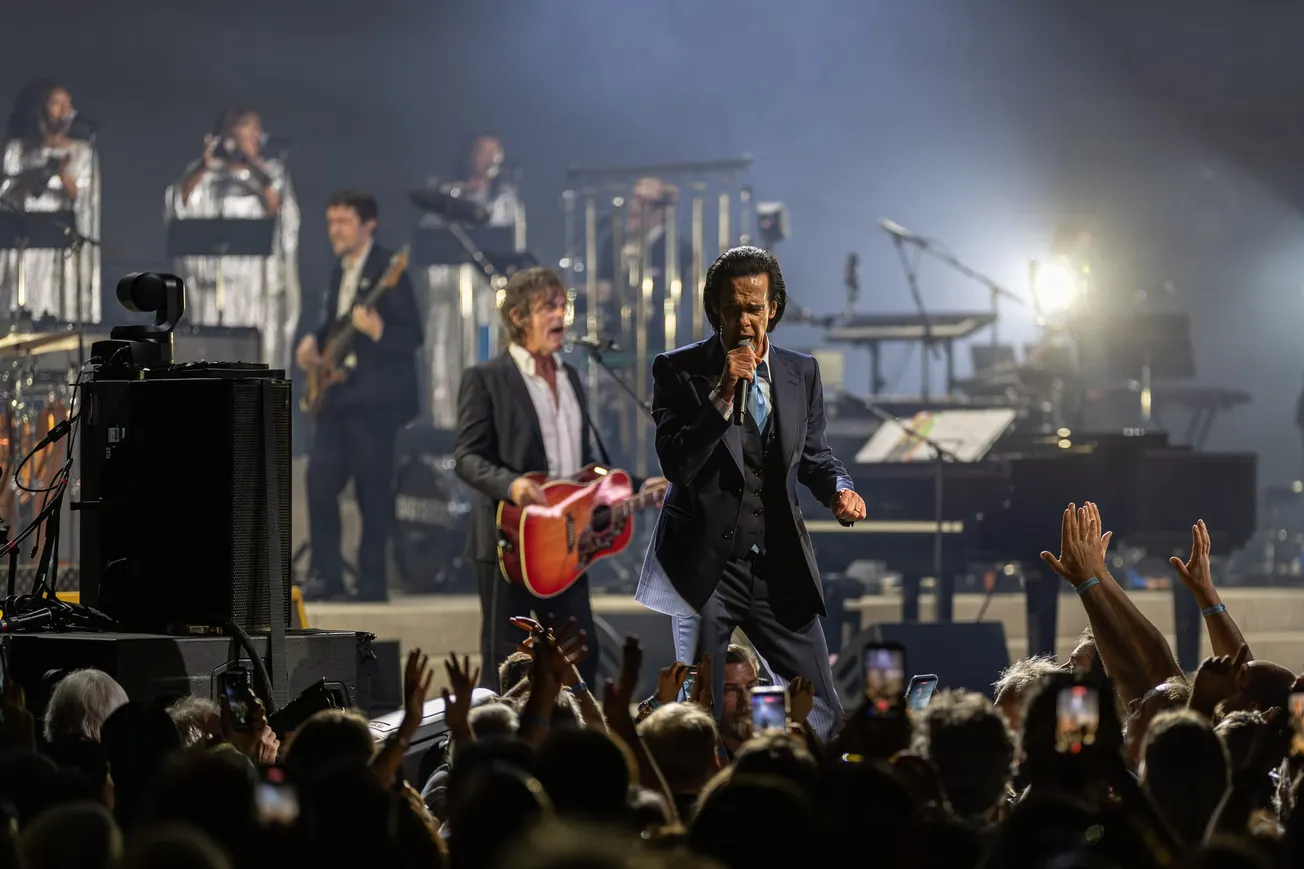


On August 22, Rhode Island native Hedge-fund manager Joseph Healey continued an unusual once-a-decade tradition at his waterfront home in Narragansett. Healey famously hired Sting when he turned 40 in 2006, followed by Lenny Kravitz for his 50th birthday in 2016.
This time, he got Maroon 5 to perform at his 60th birthday party. Thousands of strangers ended up to attend. The band performed from a stage positioned beside Narragansett Town Beach, where the public could watch for free.
The town announced the event with a wonderfully uncomplicated message:
“ALL ARE WELCOME.”
Thousands filled the sandy shoreline, while others watched from paddleboards and boats offshore. Jumbo screens carried the performance to spectators without a direct view of the stage. Parking lots were reportedly full hours before Maroon 5 began their 21-song set. The Boston Globe described a crowd stretching all the way to the water.
I know what you're thinking... Who cares about some extravagant vanity party an extremely rich person threw to hire out their favorite band for a night?
What we're looking at, however, is an accidental modern reboot of one of the oldest music-business models in existence, dating back centuries: private music patronage.
Welcome Back, Music Patronage.
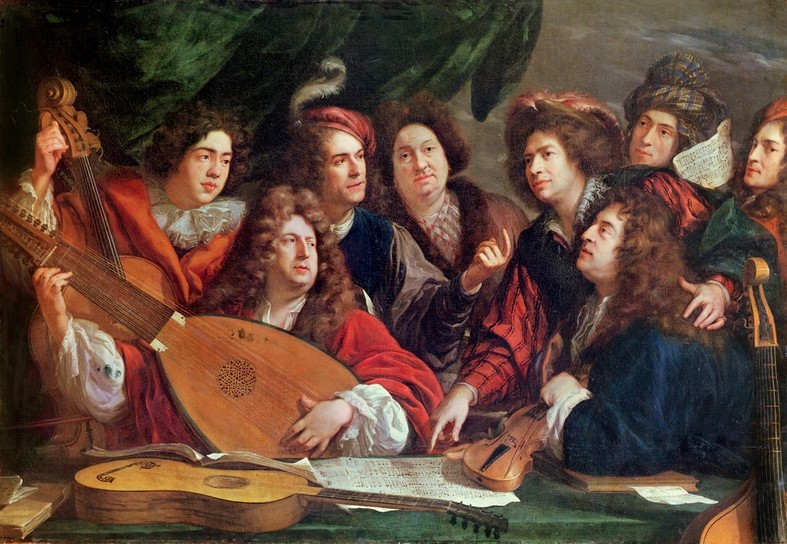
Long before ticketing companies, streaming platforms, and corporate sponsorship packages shaped the music economy as quiet giant gatekeepers, artists frequently worked with patrons to fund their composition and performance activities.
Churches, royal courts, and wealthy families commissioned music to be written, employed musicians in-house, and paid for performances. During the Renaissance, court patronage became an important source of income alongside church employment, with music also heavily functioning as a display of status and prestige.
As public concerts and music publishing expanded during the 19th century, and long-distance travel became more accessible via rail, artists became less exclusively dependent on those relationships locally, being able to find opportunities and employment elsewhere. But patronage never disappeared.
The modern music business tends to disguise the same basic arrangement beneath different language. Today, it may be called philanthropy, sponsorship, commissioning or underwriting. The central question remains familiar: Who pays for music to exist when the audience is not expected to cover that cost?
Enter Healey.
He reportedly spent at least six figures on the event infrastructure alone; a local building permit valued the temporary structure at an estimated $250,000, although that figure did not represent the concert’s total cost. Instead of keeping the experience entirely behind the gates of his waterfront property, he turned the stage toward the beach and invited the community to share it.
This was still a billionaire-scale birthday flex, but it was also a privately financed public event, experienced by thousands for free.
+Read more: "Why the Levitt Foundation Model Should Not Be an Outlier"
So, What If More Private Money Bought Public Access?
Free concerts are already supported by foundations, municipalities, nonprofit organizations, and socially conscious businesses across the country. Hypebot just profiled the countrywide free music series run centrally by the Levitt Family Foundation. In this case, one person wanted a concert, and had the funds to create it.
Public access in this scenario is completely optional, but... the possibilities for this model are endless.
- A benefactor could underwrite a neighborhood concert series.
- A foundation could commission an artist to create a performance for a particular community.
- A group of businesses could collectively finance shows without demanding that the resulting event become an enormous branded activation.
- An artist or promoter could even pitch a free public concert to one donor instead of trying to convince 2,000 people to buy tickets.
The underlying mechanism can work at almost any scale.
A donor does not need to hire an arena headliner. They could spend $10,000 supporting local artists, production workers and an independent promoter instead. They could finance a stage at a community festival, cover artist guarantees for a free venue series or pay for an outdoor performance in a neighborhood that rarely receives live entertainment investment.
+Read more: "We’ve Normalized Financial Struggle for Artists. It’s Time to Stop."
Untethering Patronage and Power
Of course, the old patronage system came with a substantial catch: the patron always holds the power. This is still the case.
When artists depend on wealthy individuals, those individuals can influence which musicians receive support, what gets performed and which communities are considered worthy of investment. Historically, patronage sustained remarkable art while also keeping artists accountable to the tastes and politics of the people writing the checks.
That's a tension that needs to be worked out in this model somehow. But in a way, an individual benefactor is an easier string to pull than an entire multinational corporation.
Private wealth should not determine an entire community’s cultural life. Public arts funding, ticket-buying audiences and independent institutions all provide necessary counterweights. A modern patronage model would work best when funders supply resources while artists, promoters and community organizations retain meaningful control over programming.
Sometimes, even on a local level, it can be beneficial to ask: Who could pay for this — and what if they invited everybody?