

By Jared Rapoza, CEO of Artist Influence
Almost every artist or manager we talk to asks us the same thing:
If we get this song on playlists, will Spotify start pushing it on its own?
It's a fair question. Playlist plays cost money, and the hope is that Spotify notices and takes it from there. A lot of people sell that idea hard. So we went through our own numbers to see what really happens.
What We Measured
We've run 1,900+ campaigns. For this we used every Spotify playlist campaign where we could see the song's Spotify for Artists numbers. That came to 410 songs. For each song we sorted its plays into three piles.
- Playlist plays. Plays from the independent playlists we put the song on.
- Spotify's own recommendations. Plays from Radio, Mixes, DJ, Smart Shuffle and Autoplay. Nobody can pitch a song into these. Spotify decides who hears it.
- The song's own fans. Everything else over the same 12 months, like people's libraries, search, the artist page, editorial and other playlists.
We counted Discover Weekly and Release Radar on their own, because Spotify builds those for each listener.
One thing to know first. Spotify for Artists adds up plays over the last 12 months, so some of these plays happened before or after the campaign. And some of a song's own fans found it through the campaign. So these numbers show what happened alongside the playlists, not proof the playlists caused it. I'd rather say that up front than have someone point it out later.
The Short Answer: Small Songs Get a Small Bump
Across all 410 songs, the typical song got about 13 plays from Spotify's recommendations for every 100 playlist plays. But that mixes small songs with songs that already had lots of fans.
Split them up and it looks very different. Songs with under 10,000 plays from their own fans got about 7 per 100 (181 songs). Songs with 10,000 to 100,000 got about 20 (138 songs).
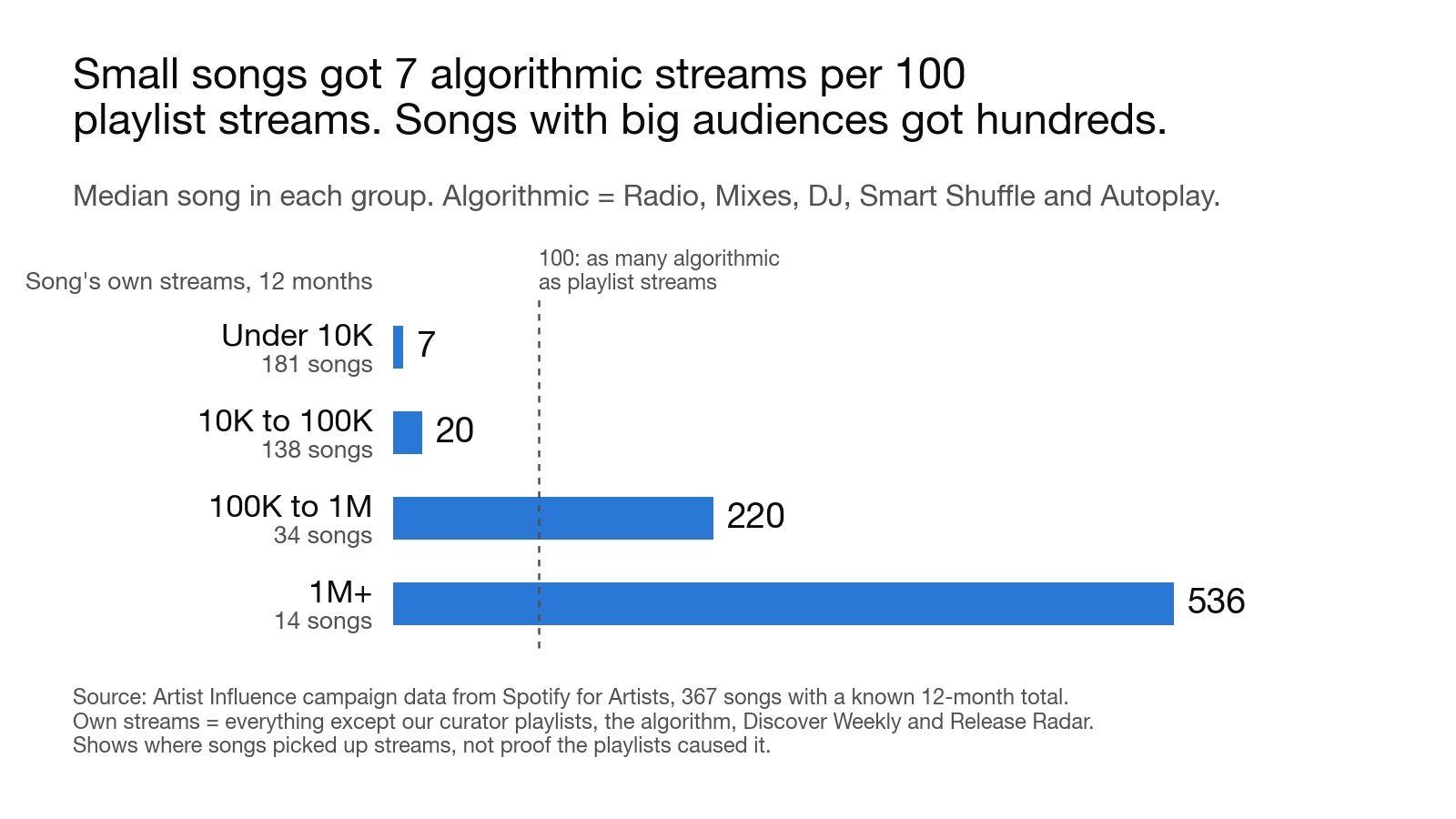
Songs with 100,000 to 1 million plays from their own fans got about 220 per 100 (34 songs), and songs over 1 million got 536 (14 songs). Those groups are small, so treat them as a direction, not a promise. The big numbers went to songs people were already finding on their own.
Most songs we run don't look like that. 68% of the 410 got under 10,000 plays from Spotify's recommendations in a whole year, even counting Discover Weekly and Release Radar.
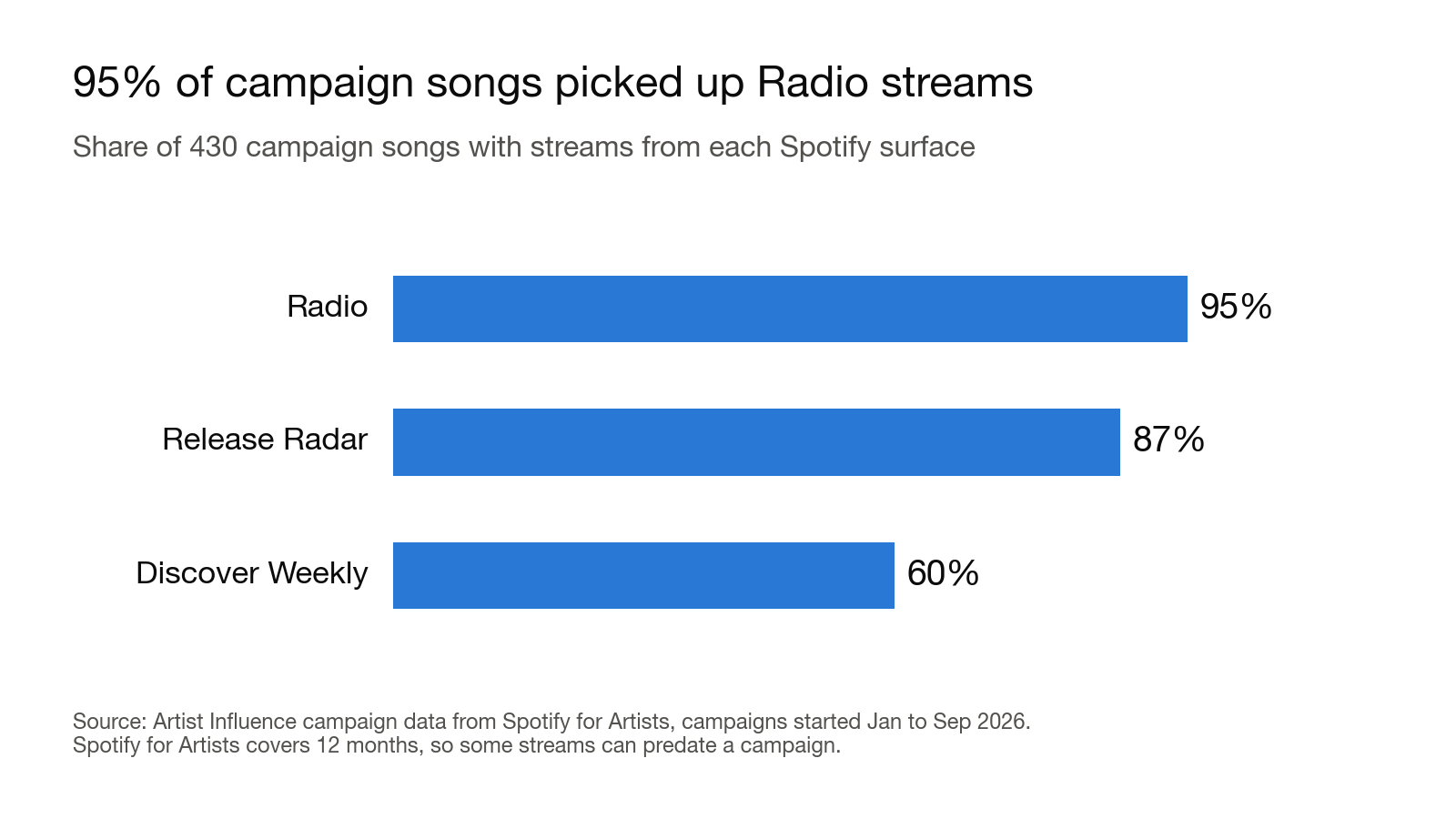
Getting at least a few plays from them was common. 95% of our campaign songs got some Radio plays, 87% got Release Radar and 60% got Discover Weekly. But showing up isn't the same as taking off, and for most songs the numbers were small.
We can't tell from this which came first, the fans or the recommendations. But if your song doesn't have many fans yet, expect a small bump from Spotify, not a flood.
The Popularity Score, and "The 30 Rule"
Every song on Spotify has a hidden popularity score from 0 to 100. You won't find it in the app, but lots of free tools show it. It goes up when a song is getting a lot of plays right now compared with everything else on Spotify.
There's one rule you hear about it all the time: get your song to 30 and the algorithm kicks in. We tracked the score week by week for 381 of our songs during their campaigns to see if that's true.
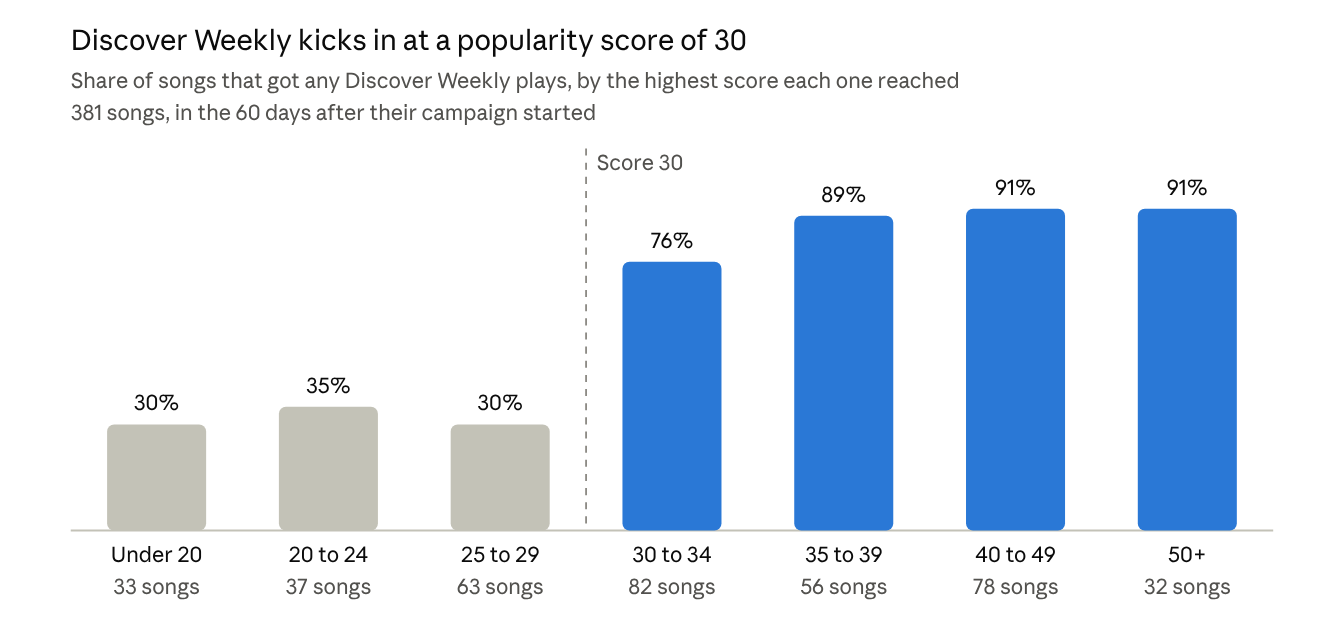
For Discover Weekly, it holds up. Songs that topped out under 30 got Discover Weekly plays about 3 times in 10. Songs that reached 30 to 34 got them about 3 times in 4. There's no other jump like that anywhere on the scale.
But 30 is where Discover Weekly starts trying your song, not where it takes off. Songs that peaked at 30 or 31 got a typical 9 Discover Weekly plays all year, and only 14% got 1,000 or more. Of the songs that peaked at 36 to 39, 59% got 1,000 or more.
The rest of Spotify's recommendations don't have a magic number. Radio, Mixes and Autoplay grow steadily as the score goes up, with no jump at 30. Release Radar ignores the score completely. It goes to the artist's followers, so 8 or 9 in 10 songs got it at every level.
Which comes first? A bit of both. The score is built from plays, so Discover Weekly plays push it up too. But if that were the whole story, you'd expect a smooth climb, not a cliff right at 30. We can't see inside Spotify, but our data says the line is real.
How long it takes. 260 of our songs started their campaign under 30, and 57% of them crossed it during the campaign. The typical one crossed 18 days in, and most crossed within 4 weeks. Songs that started at 25 to 29 crossed 91% of the time. The songs that crossed also had bigger campaigns, about 25,000 playlist plays for the typical one against about 7,600 for the songs that stayed under. That makes sense, since more plays push the score up.
In plain English: getting past 30 is what gets Discover Weekly to start testing your song with new listeners. It won't make a song blow up, but it opens the door.
How to Check It on Your Own Song
Hypebot ran a guest piece recently on what happens after the plays stop. This is the Spotify side of that, and you can check your own song the same way in about five minutes.
- Open your song in Spotify for Artists and go to the Playlists tab. Spotify's own recommendations are listed there by name, right next to the playlists.
- Add up the plays from the playlists you were put on.
- Add up the plays from Radio, Mixes, DJ, Smart Shuffle and Autoplay.
- Divide the second number by the first and multiply by 100. That's how many plays Spotify sent you for every 100 playlist plays.
- Take the song's 12-month total and subtract the playlist, recommendation, Discover Weekly and Release Radar plays. What's left is roughly the song's own fans.
- Look up the song's popularity score with any free checker, and see whether Discover Weekly shows up in that Playlists list yet.
Then find your row in the first chart, and your score in the Discover Weekly chart. You can start checking early. The typical song got its first playlist add 5 days in, and 69% had one within the first week (358 songs).
The number that matters most comes later, though. Check again a month after the campaign ends. If Radio and Autoplay are still going after the playlist plays drop off, the song is earning its own reach.

Red Flags
The big one is lots of playlist plays and nothing at all from Spotify's recommendations. A small number is normal for a small song, but almost every song we ran got at least some. If Radio and Autoplay still show zero a month after a 30,000 play campaign, something's wrong. It's usually one of three things.
- The listeners aren't real. Bots don't save songs, follow artists or come back. Spotify also removes fake plays and can take a song down over them, so this one can actually hurt you.
- The playlist is the wrong fit. A melodic house record on a gym rap playlist just gets skipped.
- It's background listening. Some big playlists are on all day at work or while people sleep. The plays count, but nobody stops to check who the artist is.
If you're paying for playlists, ask for the playlist names and check them yourself in Spotify for Artists. Anyone running real campaigns will be fine with that.
Playlists won't make a song blow up on their own. They get it in front of people. The rest is up to the song.
Jared Rapoza is the CEO of Artist Influence, a music marketing company in New York that runs Spotify playlisting, clipping, UGC, YouTube and SoundCloud campaigns for artists and labels. Since 2019 the team has worked on campaigns for artists including Skrillex, Marshmello, Jaxomy and Gordo.