

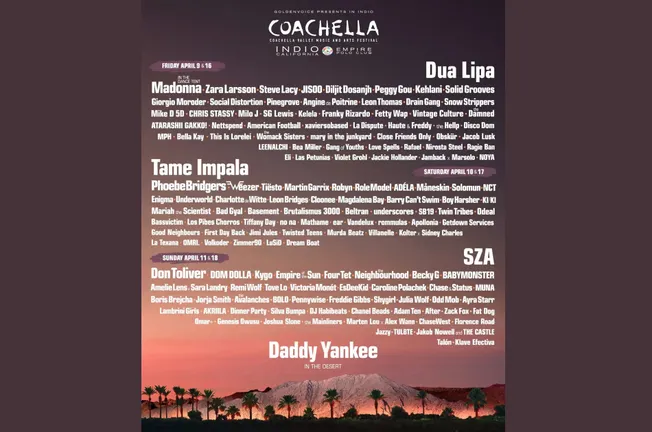
The Coachella Valley Music & Arts Festival has announced its 2027 lineup, and while Dua Lipa, Tame Impala, and SZA will take the headline slots, some of the most interesting names appear further down the poster.
Isn't that always the case? But next year, as in most years, it's the artists in the middle chunk of white text that reveal so much about where live music is right now, and what audiences can't get enough of.
The festival returns to Indio, CA, for two weekends, April 9–11 and April 16–18, with a sprawling bill that includes very different corners of contemporary music. At first glance, it's the usual Coachella balancing act: pop superstars, established alternative acts, electronic music, and enough underground discoveries to keep the festival's reputation as a cultural tastemaker intact.
Look closer, however, and the lineup suggests something deeper is going on. Here are nine bookings that tell us something about the changing business of performing live.
1. Madonna: The Biggest Artist Doesn't Always Need the Biggest Stage
Madonna could easily command one of Coachella's headline slots, any, year, of, her, life. Yet instead, she's returning to the dance tent, more than two decades after her landmark 2006 performance at the festival. It's an unusual booking that raises some questions about what her set is going to be like, and whether we might see some high-profile guests join in.
Also, by placing one of pop's biggest icons inside an environment historically associated with electronic music, Coachella is creating an event with its own identity, rather than simply another enormous main-stage production hinged on the artist's.
2. Tame Impala: Alternative Music Doesn't Have to Abandon Its Identity to Go Mainstream
When Tame Impala first emerged from Australia's psychedelic rock scene, few would have predicted that Kevin Parker's project would eventually become a Coachella headliner. Yet the band's ascent has been built on something increasingly valuable in live music: a recognizable world fans love to enter.
Tame Impala's music, visual language, lighting, and production have all evolved together in lock step, transforming a distinctive psychedelic sound into a festival-scale experience that operates for several senses at once. Parker already headlined Coachella in 2019, and his 2027 return reinforces the project's staying power.
3. Daddy Yankee: Global Genres Are No Longer Side Attractions
When was the last time you hear that name? Daddy Yankee receives special "In the Desert" billing, giving the reggaeton pioneer a prominent position outside Coachella's traditional three-headliner structure. The booking reflects how dramatically Latin music's place in the international live industry has changed.
Only a generation ago, major American festivals frequently treated Spanish-language performers as specialized programming. Today, Latin music is central to international touring, festival demand, and popular culture. Daddy Yankee's appearance also demonstrates the commercial power of genre-defining artists whose influence extends well beyond their streaming numbers. In recent weeks the singer and producer dropped tracks with Cardi B, Diljit Dosanj, and Alex Zurdo, among others.
4. Phoebe Bridgers: Scarcity Can Be a Touring Strategy
Phoebe Bridgers' appearance is especially intriguing given her relatively limited solo live activity in recent years. As streaming and social media encourage artists to remain constantly visible, Bridgers represents a different kind of momentum. Her audience has continued to grow through collaborations, boygenius, and an exceptionally devoted fan community, even without the endless cycle of solo touring that once defined an emerging artist's career.
Her Coachella booking suggests that time away from performing can increase anticipation rather than diminish it, provided the audience relationship remains strong. It challenges the assumption (for any artist) that constant availability is always the best strategy. Sometimes the most valuable performance is the one fans haven't had an opportunity to see in a while.
5. Snow Strippers: Internet Subcultures Are Becoming Real-World Festival Communities
Electronic duo Snow Strippers have built their following around a collision of distorted dance music, alternative aesthetics, and internet-native culture. Their Coachella appearance is another sign that festivals are increasingly looking beyond traditional indicators of commercial success when identifying emerging acts.
What matters isn't necessarily whether an artist has crossed into mainstream radio or achieved a conventional chart breakthrough. It's whether they've developed a community with a recognizable identity, shared tastes, and a willingness to show up. A concentrated audience of highly engaged fans can absolutely be more valuable than a much larger but less invested population of casual listeners. Online communities become especially interesting to promoters when their enthusiasm translates into real-world participation.
6. Giorgio Moroder: Electronic Music Has Its Own Living Legends
Electronic music has always been particularly good at reinventing itself. It's also learning how to celebrate its own history, and with the passing of Juan Atkins recently, it seems that Coachella wanted to make sure it, too, was paying tribute to influential artists before it's too late.
Giorgio Moroder's appearance introduces one of dance music's most influential architects to a festival audience that includes generations of listeners who weren't alive during the disco era. Moroder's importance extends from his pioneering synthesizer productions to the foundations of modern electronic pop. His booking recognizes that dance music's history itself (and maybe a little bit of disco too) is becoming a valuable live proposition, on stages previously dominated by pop and rock bands.
7. BABYMONSTER: K-Pop Is Redefining the Live-Performance Standard
BABYMONSTER's inclusion illustrates the continuing importance of K-pop up and down the fame ladder within that genre, within the international festival economy. But beyond the genre's global commercial success, there's something particularly instructive about its approach to performance.
K-pop treats choreography, visual presentation, branding, and audience participation as interconnected elements of the live experience. Performance is not simply a way to reproduce recorded music. It's a carefully developed product in its own right. The resources supporting major K-pop productions are far beyond those available to most independent artists, but there remain invaluable lessons that any artist can take away from K-Pop's unique architecture.
8. Lambrini Girls: The Underground Is Still Supplying the Energy
We can't stop talking about punk trio Lambrini Girls lately, who have been building momentum through confrontational performances, relentless touring, and an audience that participates physically rather than simply watches. Their presence on Coachella's lineup demonstrates that the festival still sees value in artists whose appeal comes from grassroots live culture.
In an industry increasingly focused on digital discovery, there's something significant about an act whose reputation is inseparable from what happens in the room. The mosh pit becomes a community-building tool. The concert becomes a place where online enthusiasm transforms into shared physical experience.
9. Justice: A Festival Performance Doesn't Even Have to Be a Concert
Lastly, one of the lineup's most unusual announcements is the Bunker debut of Justice — Blinded by the Lights. While the precise format has yet to be fully detailed, its separate billing suggests that Coachella is making room for experiences that don't fit neatly into the traditional "concert" schedule.
That's an important development these days, considering how many live concert films are touring cinemas, as well as the rise of virtual reality concerts, immersive 360 dome experiences, darkened concerts of orchestral music, and others. Festivals increasingly compete not only through the artists they book, but through the environments, installations, and experiences that attendees encounter between performances.
Coachella Is Selling More Than a Lineup
For Coachella, the product isn't simply three headliners and a collection of supporting acts. It's the expectation that something significant will happen, whether that's an unexpected performance, a reunion, an unusual collaboration, or the discovery of an artist audiences didn't know they needed to see.