

One of my best friends was an actor and like most actors, he didn’t enjoy and sometimes struggled with the audition process. Then he produced and directed a few productions and found himself on the other side of the casting table. It was a revelation.
All of a sudden, a bunch of things came into focus: directors want the actor to be good, they’re rooting for the actor, and mainly want to know if the actor is somebody they want to hang with for weeks at a time. These “two sides” are not, in fact, adversarial, and much better understood when somebody has been on one side or the other.
I started thinking about this dynamic as it pertains to the musician-critic relationship, and how if we just understood the other party better, everyone's jobs and expectations would be smoother.
The Artist-Journalist Detente
Musicians and critics. They’re in the same ecosystem in a symbiotic relationship where one needs the other. Just like my actor friend, I can write about this drawing on some personal experience; I’ve been a reviewer for years, and for 18 years now I’ve been releasing music that gets reviewed.
It’s a double life, sure, but I would argue that filling both roles has given me a deeper understanding of what bands and critics should realize about each other.
What Reviewers Often Don't Realize About Musicians
In my opinion, here are the things we musicians feel journalists will often get wrong when engaging with a work.
1) Review the Record in Front of You
When a musician makes an original album, it’s demoralizing to have the reviewer go off on a jag that it would have been better if it had more of an Andrew Bird feel. Review the record. Don’t detail what the album isn’t — or don’t use this as your forum to blanket criticize shoegaze music or heavy metal at large.
2) Oh Lord, Please Don’t Let Me Be Misunderstood
On the nose, accurate criticism doesn’t hurt as much as a flippant incorrect comment based on 1 or 2 quick listens. We artists don't mind a bad review if it's coming from an informed, genuine place, we care if you don't even take the time to listen thoroughly.
3) The Artist Has Heard Their Album 100x More Than You Have
If you hear some unusual phrasing or oddball note, that’s not an “aha” or “gotcha” moment to catch the artist in a mistake. More often than not, it's played that way on purpose or it's left in there on purpose. Treat it like a decision and not an error.
4) Reviews Mean Two Things to a Band
First of all, we're trying to expand our listenership, so thanks for talking about our record at all. We're grateful just to be on your site, good or bad. Secondly, what would be great no matter what, is to be able to capture a pull-quote for our website, EPK, social media, or mailing list. A rave review is always great, but even a mediocre review can be helpful if there's some intentionality to the writing.
5) Don’t Be a Mind-Reader
“I’ll bet the singer was trying to XYZ”... Nope. You’re probably incorrect about the artist’s intent. Open your mind, buddy.

+Read more: "The Modern Guide to Getting Your Music Played on Radio"
What Musicians Often Don't Realize About Critics
And now to present the other side of the coin; what we musicians seem to not be able to grasp about the journalist's role.
1) It’s Not the Reviewer’s Job to "Promote" Your Record
Don't confuse necessary PR agency and reviewer coordination or communication for meaning that everyone is on the same team. For critics, the music is the raw material for their review, and the reader is the customer.
2) The Overwhelming Sameness of Releases
There's not too much that bands can do about this besides just making a great record. But the stack of things that critics hear can start to blur together after a while, and we really have no idea how tall that pile of promo discs on their desk actually is. Some sympathy for that, and a bit less entitlement on the part of the artist or label, goes a long way. Critics are going to overvalue something that leaps off the speakers instead of something that requires a seventh listen to really digest.
3) Supplemental Materials
Critics need something to help do their job, like a one-sheet or EPK. Give them some basic facts they can use in their reviews like hometown, previous bands, and your self-defined genre.
4) Cheesy, Fake, or Bad PR Work
That said, claims like “sounds like a Frank Zappa orchestra recast as a New Orleans second line” are painful to read, and can annoy the reviewer. Advice sites tell you to make some wacky description to pique a writer’s interest; please, don’t be that guy.
On another level, don’t claim you’re bigger than you are or pretend that you’re a publicist when you and I both know the artist is writing this themself (which by the way, is not a deal-breaker!). Thus...
5) Just Be Yourself?
If you’re a fledgling DIY artist who works in a FedEx/Kinko’s, be honest. You’ll be amazed at how much the critic will get on your side and empathize with that experience. If you’re at this level, the reviewer probably isn’t writing for Rolling Stone.
6) Tension Between Honesty and Trashing an Album
On the indie level, most critics really don’t want to torch an artist with a catty, negative review. There’s an obligation to the readers, yes, but only sociopaths enjoy trashing an aspiring singer.
Yeah Okay, We All Get It Wrong
Nobody’s perfect, and both musicians and critics can be guilty of getting high on their own supply.
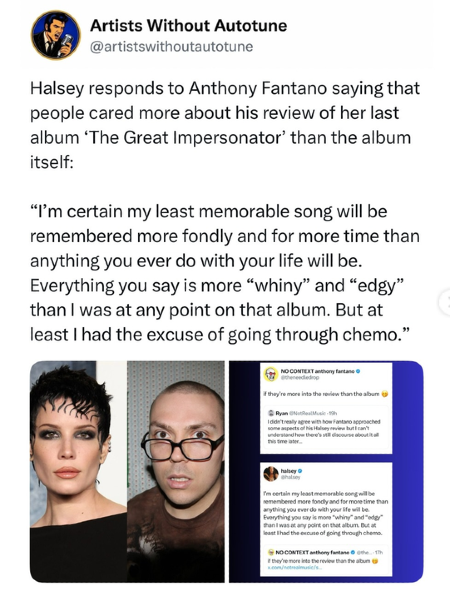
Bands have slaved over and lived with these recordings for a long time. When a critic doesn’t “get it” or just doesn’t like it, that can be painful. Sometimes the artist is having a bad day and lashes out, like Halsey here lashing out to Anthony Fantano:
Conversely, critics can really disappear up their own asses sometimes. Not every music writer has the chops to write creative departures like Lester Bangs or Greil Marcus. And worse yet are meaningless critic-speak drivel that tells readers nothing — and signals to the band being reviewed that the writer doesn’t have a clue.
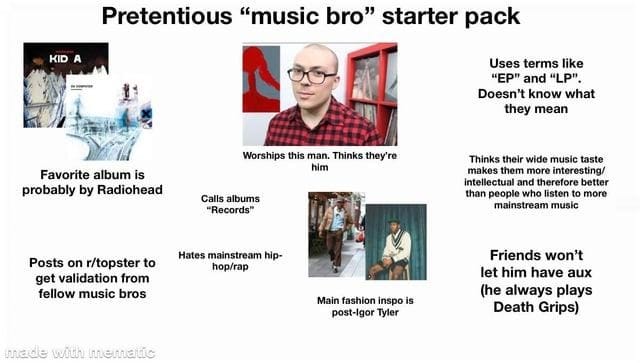
Pretentious language like “memorable melodic construction,” "cinematic grandeur," "cinematic backdrop", or "sonically ambitious" actually doesn’t describe anything. You know the type, as seen in Reddit meme here...
The longer I’ve done both jobs, the more I realize how easily both sides misread each other.
Understanding = Good
In general, it's always a net positive to experience walking a mile in someone else's shoes professionally. I always felt tense going into a job interview until I started interviewing applicants myself. I eventually realized that the main thing I was interviewing or screening for with already-qualified applicants was: “Could I tolerate having lunch with this person once a week?”
Empathy and understanding between artists and critics is crucial.
Music writers and musicians have more similarities than differences. We all love music, unfortunately for our spouses. Their work is a labor of love in both cases; odds are, neither reviewer nor songwriter is getting paid much. And all of us are fighting for competitive spots in industries whose best days are behind them.
But when things are right, both jobs are damn fun to do.
The Most Important Person in the Music Ecosystem
I’ve written nearly 1000 words already without mentioning or acknowledging the key beneficiary in this whole relationship: the music consumer.
- Artists need to give LISTENERS something they can't get anywhere else.
- Critics need to give READERS information they can use: what does it sound like, would this be up their alley?
If I'm making music, my job isn't to impress reviewers. If I'm reviewing music, my job isn't to flatter musicians. In both cases, my responsibility is to the audience. The listener and reader.
+Read more: "4 Tips to Triple Your Merch Sales at Your Concert"