


The independent working-band tour has not disappeared. Far from it. And since COVID changed the economics and logistics of touring in a highly contained short-term timespan, data suggests the operations of the average tour have barely changed at all in the long-term.
That is the most useful takeaway from Bandago’s newly published State of Band Touring 2026 report, which analyzes 1,532 verified music tours completed between August 2025 and July 2026 and compares them with several earlier touring seasons.
Bands do tend to put in a lot of miles, though. The average tour lasted 16.1 days and covered 4,334 miles. The median (or more typical) run is about 12 days and 3,135 miles. Music tours alone put 5.9 million miles on Bandago rented vehicles during the year.
But this story isn't really to show that bands still drive a lot. It's about the numbers which suggest that the basic shape of a tour has remained surprisingly stable while almost everything required to execute one has become more deliberate.
The middle held. The outer edge stretched.
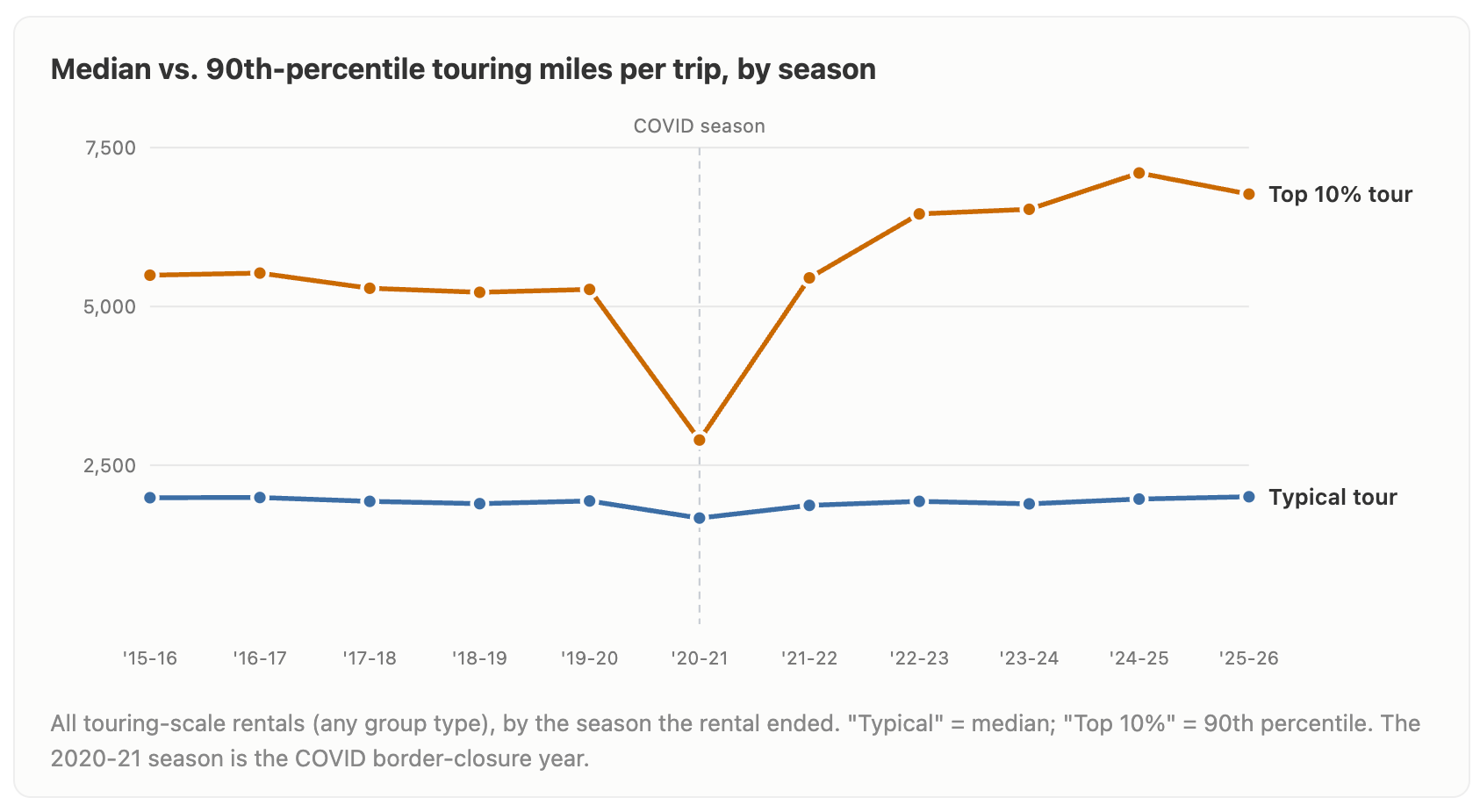
Across all touring-scale rentals, defined as trips of at least 1,000 miles and four days, the median distance has hovered around 1,900 to 2,000 miles for most of the past decade. In other words, the standard van tour did not radically expand after the pandemic.
The longest runs did however. A tour at the 90th percentile covered 6,769 miles in 2025-26, compared with 5,222 miles in 2018-19 — an increase of almost 30%. One in ten music tours in the latest season exceeded 9,700 miles. That suggests a split in the touring economy.; the artists and crews operating at the more ambitious end are asking much more of every vehicle, routing decision, and person on board.
Additionally, the average indie band reserved its van 35 days before departure last season, compared with 21 days in 2015-16 — which doesn't necessarily mean artists have become less spontaneous, it just may mean that vehicles, venues, crew and affordable routing now have to be locked together earlier for the numbers to work.
+Read more: "Why the Levitt Foundation Model Should Not Be an Outlier"
Touring is decentralizing.
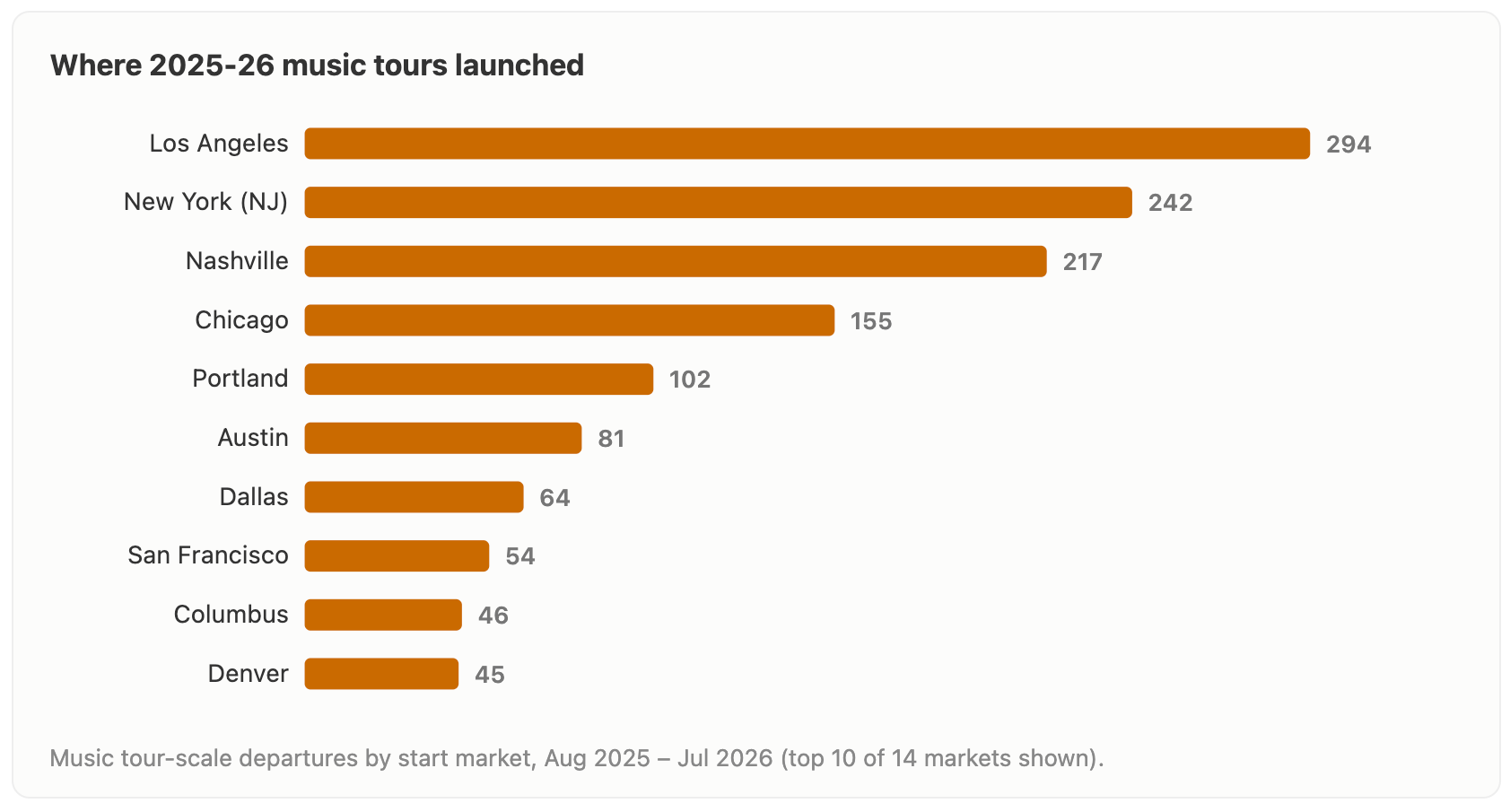
A decade ago, Los Angeles, New York and Nashville accounted for 64.8% of Bandago’s music-tour launches. Last season, their combined share was 52%.
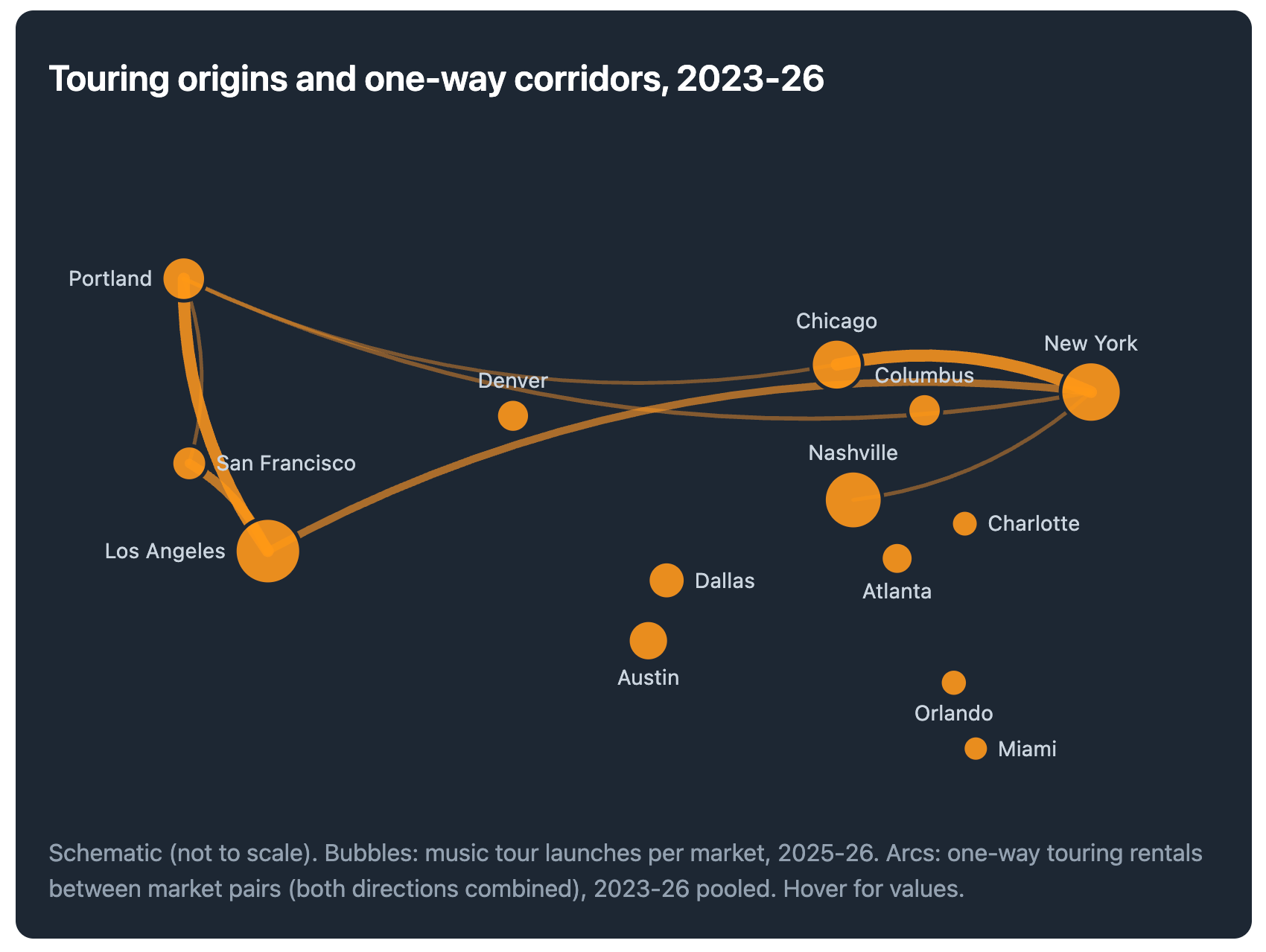
The three hubs still matter enormously — Los Angeles alone launched 294 tours, followed by New York with 242 and Nashville with 217 — but more runs are now originating in markets including Chicago, Portland, Austin, Dallas, Columbus and Denver.
This complicates the old idea that a serious touring career must be built from one of three industry capitals. The live network is becoming more distributed, at least within Bandago’s 14-market footprint.
Routing is changing with it. The share of touring rentals returned in a different city from where they began rose from 11.7% in 2015-16 to 19.2% last season. More tours are functioning as point-to-point journeys rather than neat loops back home, with especially active corridors along the West Coast and between New York and Chicago.
The road is becoming less international
The report’s most concerning finding is the decline in international acts touring the United States. International customers accounted for 7% to 8% of Bandago’s music tours before the pandemic and recovered to 7.7% in 2022-23. Their share has since fallen for three consecutive seasons, reaching 4.7% in 2025-26 — the lowest level in the dataset outside the border-closure period.
That translated to 72 international tours last season, down from 122 in 2018-19. Canadian acts experienced the sharpest decline, falling from 31 tours to roughly a dozen.
Bandago notes that this slide coincides with higher costs and tighter U.S. visa and border conditions, but its rental records cannot establish why it is happening. The data also identifies a customer’s country through billing information, meaning foreign artists renting through American management may not appear as international.
Even with those caveats, a three-year decline after a complete post-pandemic recovery is difficult to dismiss as a reopening hangover. For American audiences and venues, fewer visiting working bands means a narrower cultural exchange below the arena level. For international artists, it suggests the U.S. van tour is becoming a harder proposition to justify.
+Read more: "How to Build a Greener Concert Industry"
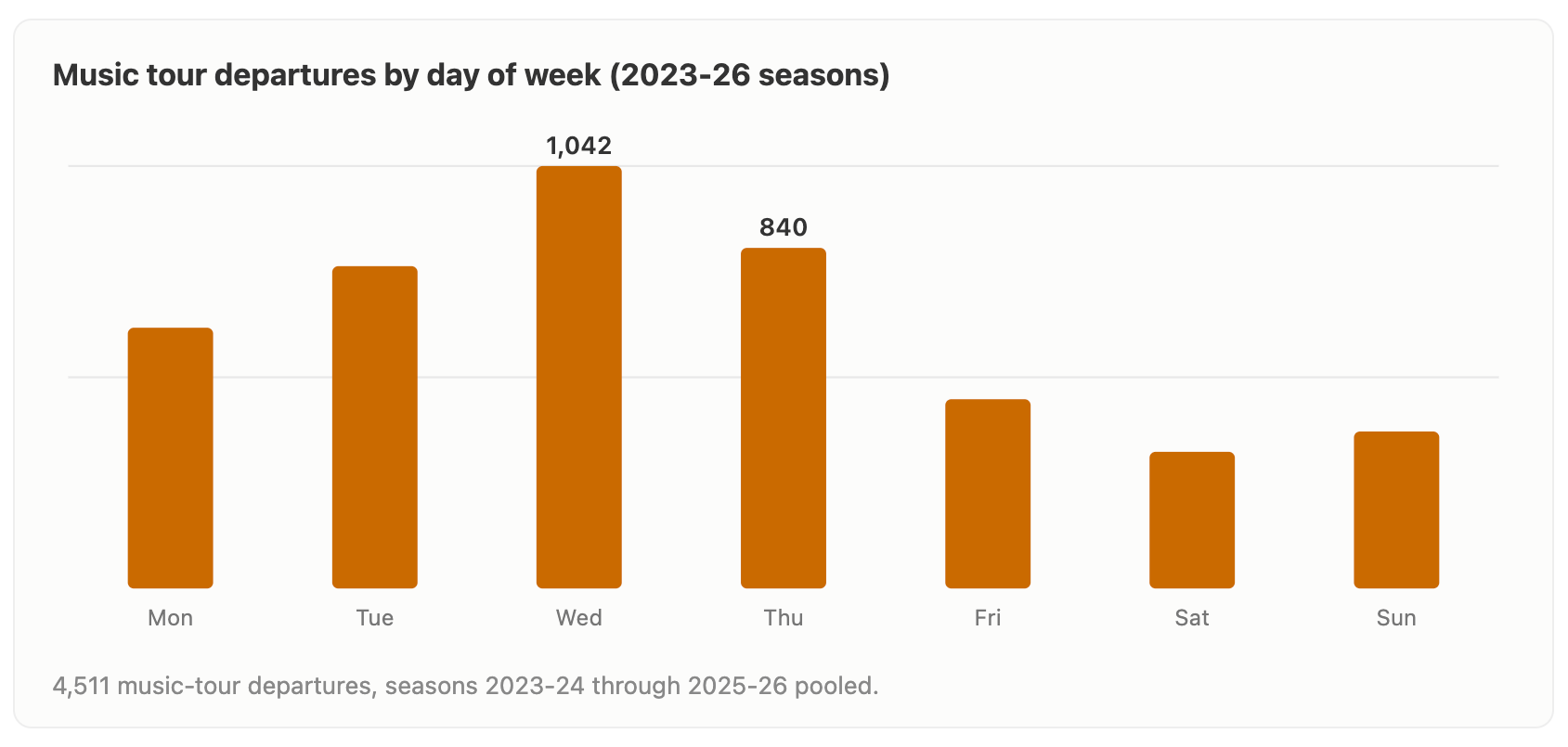
Bands leave on Wednesday for a reason
Some of the report’s smaller findings are very fun. Wednesday was the most common departure day, and 59% of tour launches occurred between Tuesday and Thursday.
The likely strategy is familiar to anyone who has ever routed a run: use smaller weekday shows to travel outward, then reach the strongest markets when audiences are available on the weekend.
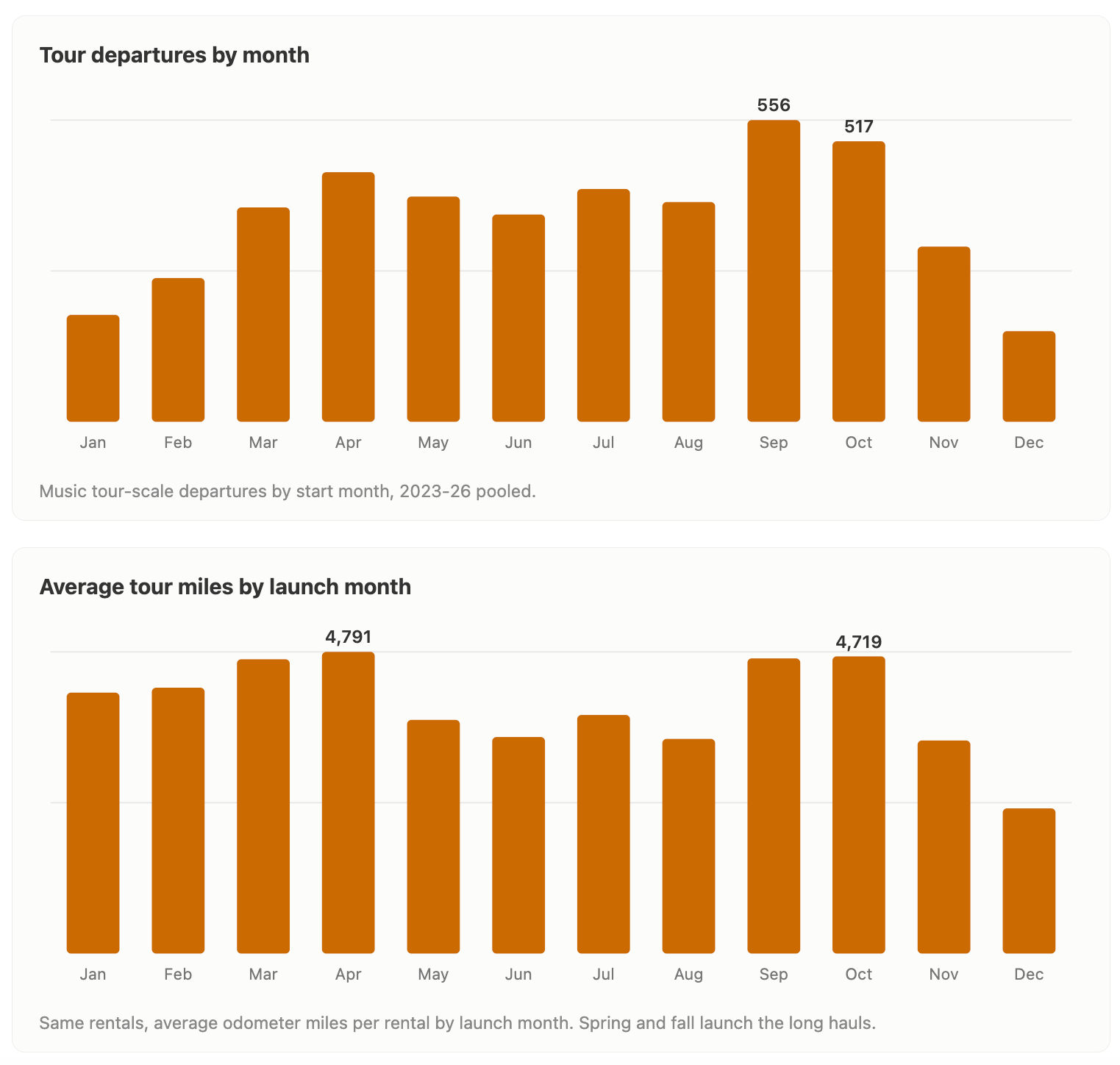
September was the busiest launch month, while April and September produced some of the longest tours. Summer may own the public image of live music, but working bands appear to reserve spring and fall for the serious mileage.
All in all, this data tells us something useful and actionable. Tours can still be spontaneous, short, cheaply executed and highly effective for indie artists, but they might require a little extra planning and professionalism to deal with all the external factors of the road.
Pulling a van tour off now means booking earlier, routing across a broader network, building around the calendar, and preparing for plans to change anyway.
Methodology note: Bandago analyzed a fixed data set of anonymized rental records from 1,532 verified music tours completed in 14 U.S. markets. The company describes the dataset as a large sample of working touring groups, not a census of the touring industry. Simultaneous multi-van rentals are counted as separate vehicle-tours.