



By Adam Fitzgerald, Founder of Legless Records and Blackbox RMS
The missing middle of music technology
The music industry has developed excellent tools for making music, distributing it, promoting it and measuring what happens afterward. What has received far less attention is the operational work in the middle.
That middle begins when a track is accepted and continues long after it appears on streaming platforms. Someone has to confirm the version being released, collect the correct artist information, artwork, credits and identifiers, issue the contracts and make sure they are returned and correctly completed. Deadlines need to be tracked, masters approved, promotional campaigns prepared and any changes recorded. Months later, royalty data must be matched back to the correct release and the agreement that determines how the income is divided.
For a large company, those responsibilities can be distributed among departments.
For a small, growing or mid-sized independent label, they are often handled by one or two people, usually late at night, while they juggle A&R, marketing, social media, accounting and artist support. Self-releasing artists face much the same problem: independence gives them control, but also every administrative job that used to sit somewhere else.
The industry often celebrates access to tools, and rightly so. Artists and labels now have resources that would once have been unavailable to them. But access to twenty separate tools does not automatically create an effective working system.
Sometimes it simply creates twenty different places where information can be lost.
How I found the problem
I did not set out to build music software. I set out to run a record label properly.
I have spent more than 30 years around underground electronic music as a DJ, producer and, eventually, a label owner. When I relaunched Legless Records, I expected the difficult parts to be finding good music, earning artists’ trust and getting releases heard in an overcrowded market. Those things are difficult, of course. What surprised me was how much of my time disappeared into administration.
Every release brought another contract, master, radio edit, piece of artwork, metadata sheet, release date, set of artist links, promotional campaign and, eventually, royalty statement. None of those jobs was unusual on its own. The problem was that they all lived in different places.
The contract was in one folder and the master in another. The final metadata might be in a spreadsheet, unless the artist had sent an updated version by email. Release dates were in a calendar, promo contacts somewhere else, feedback arrived through another system and royalty reports came back months later in a completely different format.
I was not running one release. I was chasing pieces of the same release across several apps.

+Read more: "The 88% Problem: Why Most Music Fails Before Anyone Hears It"
A spreadsheet is useful, but it is not a release management system
I have nothing against spreadsheets. I still use them. They are flexible, familiar and excellent for many jobs, but the problem begins when a spreadsheet is expected to become the label.
A spreadsheet does not know that a contract is still unsigned, that an artist sent a replacement master after the metadata was finalized or that a reminder is needed before an exclusivity period ends. It cannot connect a royalty line back to the agreement that determines how the money should be divided.
It only knows what somebody remembered to type into it.
That may be manageable with two releases. It becomes much more fragile with twenty, fifty, or several hundred, when the concern is not only workload but continuity.
A label should be able to open a release years later and see what happened, which files were approved, what was agreed, what changed and what is still due. An artist should be able to do the same with their own catalog. Instead, important knowledge often lives in the label owner’s memory, which works until the catalog grows, another person joins the team, a laptop fails or somebody needs an answer quickly.
“Ask the person who remembers” is not infrastructure.
More software has not solved the problem
The usual response to operational pressure is to add another app. Need contracts? Add contract software. Need project management? Add a task manager. Need promo? Add a promo platform. Need cloud storage? Add another subscription. Need royalty accounting? Add another system.
There is a product for almost every individual requirement, from calendars and contact databases to artist intake and metadata checking. Many are very good at what they do. The problem is what happens between them.
Every additional system creates another login, another bill and another source of information to keep current. A change made in one place may also need to be made in three others, assuming somebody remembers where those versions exist.
This is where I believe music technology gets the process wrong. It treats each administrative function as a separate problem, even though labels and artists experience them as connected parts of the same release. The technology supporting it should be designed accordingly.
A release is not a collection of unrelated administrative jobs. It is one continuous process.
Professional systems should not be reserved for major companies
There is still a strange idea in parts of the industry that smaller labels should accept disorder as part of being independent. The chaos is sometimes treated almost as proof of authenticity: manage everything yourself, improvise constantly and somehow remain focused on the music.
I do not believe professionalism makes a label less independent. I think it protects that independence.
Good systems do not decide what music you release or replace judgment, relationships and taste. They reduce the time spent searching for files, copying information between applications and correcting avoidable mistakes.
That matters because administration has a real creative cost. Every hour spent working out which metadata sheet is current is an hour not spent listening to demos, supporting an artist, planning a release or building an audience. Preventable mistakes also damage trust. A missed deadline, outdated file or incorrect statement may look small, but to the artist affected, it shows how seriously their work is being handled.
Labels and self-releasing artists do not need stripped-down toys.
They need professional tools built around how they actually work, priced and designed for organizations that may begin with only one person.
Why I built Blackbox RMS
Blackbox RMS came directly from this frustration.
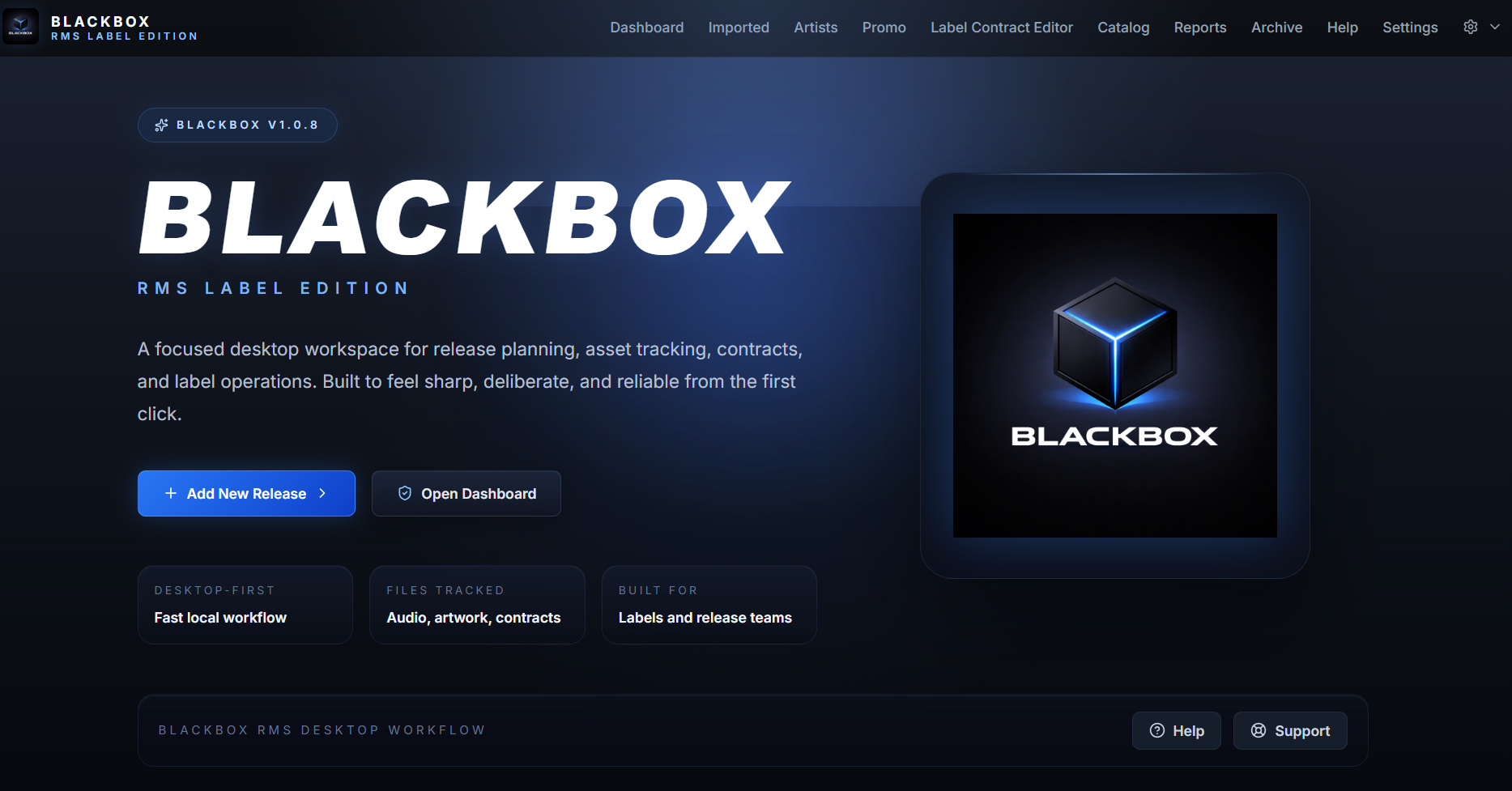
I was not trying to build another distributor, streaming platform or generic project manager with music terminology added on top. I wanted one place where a release could be managed from beginning to end.
That meant bringing the practical parts of the process together: releases, artists, contracts, files, metadata, reminders, mastering, promotion and royalties. It also meant creating different editions for labels and artists, because the underlying problem is shared even when their day-to-day workflows are not identical.
The purpose is simple. A release should have a home.
When somebody opens it, they should see the current information, relevant files, the agreement behind it, completed work and anything still outstanding. They should not have to reconstruct the history from an email chain and three folders with “FINAL” in their names.
Blackbox is the product I wished I had when I relaunched my label. Building it also clarified something much broader for me.
The industry does not have a shortage of software. It has a shortage of connected thinking.
The future of independence needs better infrastructure
Music will always be messy in the best possible ways. Artists change their minds, release plans move and unexpected opportunities appear. Creative work does not travel in a perfectly straight line, nor should it. The systems surrounding that work, however, do not need to be chaotic.
We have spent years making it easier to create and distribute music. The next step is making it easier to manage everything that happens once a track leaves the studio.
That does not mean replacing people with automation or turning every label into a corporation. It means giving people a clearer view of their work and allowing technology to carry more of the administrative burden.
Most people enter music because they care about music. Very few dream of maintaining spreadsheets at midnight. Administration will never disappear, nor should it. Contracts, credits, metadata, deadlines and accounting matter, but they should not consume the time needed for decisions that genuinely require human judgment.
A release should not live in six expensive apps, four folders and somebody’s memory.
It should exist as one complete, accessible body of work. And in 2026, that should not be a radical idea.
+Read more: "How to Plan a Release Strategy That Spans the Entire Year"
Adam Fitzgerald is an Ireland-based DJ, producer and founder of Legless Records, with more than 30 years in underground electronic music. He is also the founder of Blackbox RMS, a release management system built to help record labels and artists manage releases, contracts, metadata, files, promotion and royalties in one connected workspace.