

AI-generated music has quickly moved from novelty to operational challenge.
Over the last year, the conversation around AI music has evolved beyond questions of creativity and copyright. For streaming platforms, distributors, labels, publishers, and rights organizations, the more immediate concern is becoming surprisingly practical: how do you actually know whether a piece of music was created by a human, an AI system, or some combination of the two?
That question is becoming harder to ignore as the volume of AI-generated music continues to grow. According to figures released by streaming service Deezer, the platform is now receiving roughly 75,000 fully AI-generated tracks every day — representing a significant share of all music uploaded to the service.
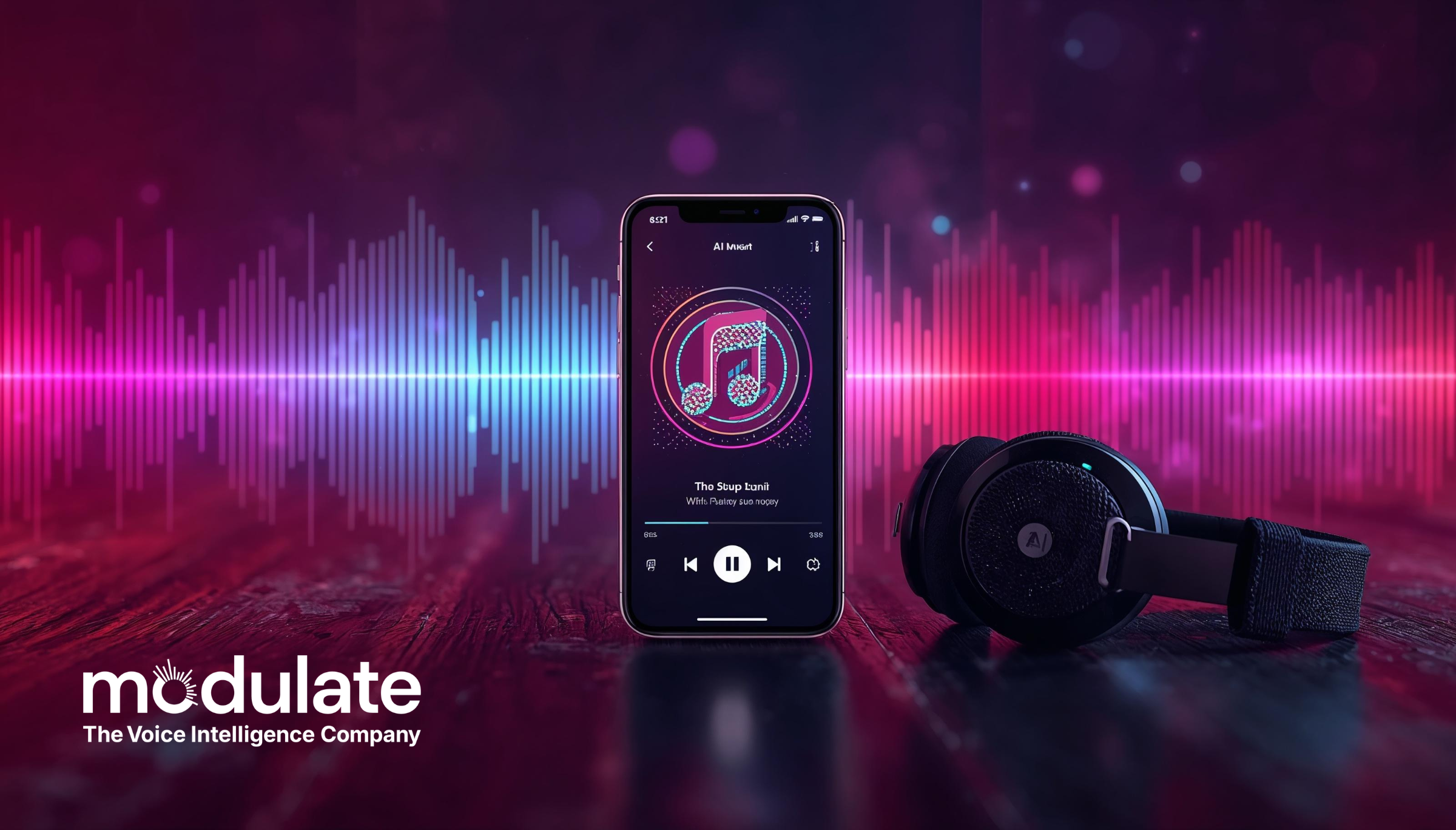
This week, Boston-based audio intelligence company Modulate announced a new AI Music Detection API designed to help music platforms identify AI-generated vocals and instrumentals directly from audio files, rather than relying solely on metadata or creator disclosures.
+Read more: "5 Signs a Spotify Playlist Is Fake (and How Playlist Bot Checkers Actually Work)"
While many companies have focused on transparency initiatives that depend on artists, labels, or distributors voluntarily identifying AI involvement, there's growing recognition that self-reporting alone may not be enough. As AI music generation tools become more accessible, platforms are increasingly looking for ways to independently verify what they're receiving.
Modulate says its system can analyze music and separately evaluate vocals and instrumentals for signs of AI generation, producing segment-by-segment assessments rather than a simple yes-or-no result. The company argues that this level of detail is necessary as the industry moves beyond the idea that every track can be neatly categorized as either "human" or "AI."
The technology also arrives amid growing concerns about streaming fraud. Industry observers have pointed out that AI tools make it easier than ever to mass-produce recordings that can then be uploaded and potentially used in fraudulent streaming schemes.
Of course, detection technology alone won't solve every challenge AI presents to the music business. Questions around copyright, attribution, licensing, and artist consent remain far from settled. But as AI-generated music becomes a larger part of the ecosystem, many industry stakeholders are beginning to view detection as foundational infrastructure rather than a niche feature.
For independent artists, the debate is less focused around whether AI should exist in music creation, and more about how to prove that legitimate creators aren't lost in an increasingly crowded sea of synthetic content.
+Read more: "Indie Artists May Soon Negotiate Directly With AI, Streamers"