How to Reach 10,000 Streams on Spotify
By CD Baby for DIY Musician Blog
10,000 streams is a sign that you’re leading a real, sustainable presence on Spotify. You’ve built a fanbase, proven you can promote yourself, and developed a strategy that works – you’re no longer hustling for every single stream.
But now it’s time to keep that momentum going — not by testing all new ideas, but by getting serious about what’s working and setting more ambitious goals. In this guide, we’ll cover some key levers independent artists can use to reach 10,000 streams – from press coverage and playlists to royalty collection and networking.
We’ll pick up where our 1,000 streams and 5,000 streams guides left off. If you haven’t read those first, start there.
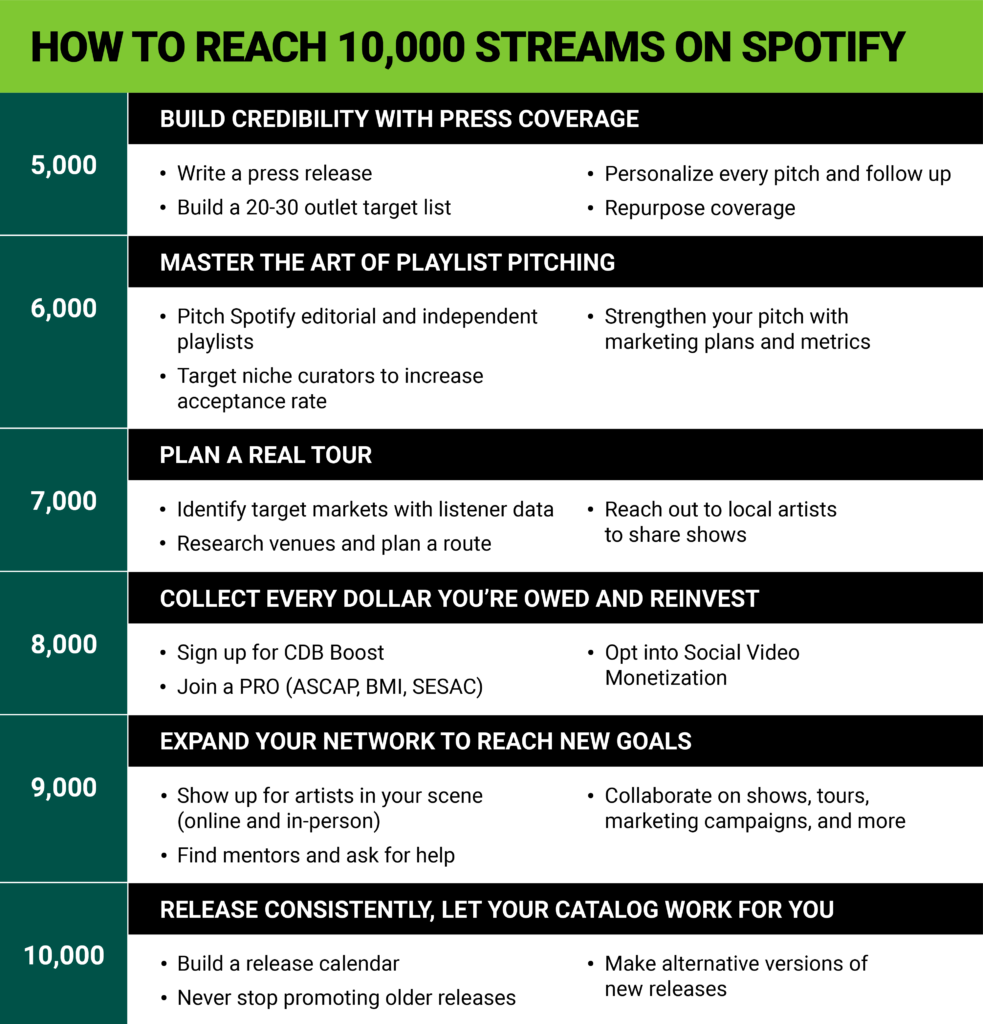
5,000 streams: Build credibility with higher quality press coverage
With 5,000 streams or more, you’re in contention for more legitimate coverage from national and regional publications, which will help you reach new fans in niche markets. These niche markets are critical – they’re filled with fans who know what they like and will double-down on artists they love.
The key to getting coverage from these publications is not only writing a strong press release, but strategically pitching it to writers. Round up 10 – 20 journalists who seem like a good fit and personalize an email pitch to each of them. Reference a specific article the journalist has published, explain why their readers would connect with your music, and keep the opening to two or three sentences. A targeted pitch to 20 outlets will almost always outperform a mass email to 200.
Key actions:
- Create a press release telling the story behind your music
- Research outlets that have covered artists similar to you and build a targeted list of 10 – 20 journalists
- Write individual pitches — reference the outlet’s recent coverage and explain the connection to your music specifically
- Follow up once, about one week after your initial pitch, if you haven’t heard back
- Repurpose any coverage you receive: share it across socials, add it to your EPK, and reference it in future pitches to larger outlets
6,000 streams: Master the art of playlist pitching
Gaining high quality press coverage increases the buzz around your music, which you can cite when pitching playlists.
Always pitch Spotify editorial playlists. Even if you don’t land a major placement, pitching guarantees your track appears on followers’ Release Radars and gives Spotify the metadata it needs to recommend your music algorithmically. Make your pitch stand out by mentioning a few playlists you’re targeting, briefly explain your marketing strategy behind your release, and include standout metrics from previous recent activity.
Consider pitching independent curators, too. Platforms like SubmitHub, Groover, and Playlist Push aggregate playlists and allow you to pitch independent curators for consideration more efficiently than finding them in the wild.
Never use services that guarantee streams though. They frequently rely on bot listens, which can result in your music being removed from Spotify. Follow CD Baby’s playlist pitching best practices to keep your music safe.
Key actions:
- Research curators on SubmitHub, Groover, or Playlist Push who actively cover your genre and have playlists with engaged follower counts
- Listen to each target playlist and write a pitch that references specific tracks already on it
- Pitch your Spotify editorial playlist submission at least seven days before your release date through Spotify for Artists
- After a placement, thank the curator publicly on social media and tag them — it builds the relationship for future releases
- Track your pitches in a simple spreadsheet: outlet, date, outcome, and any feedback received
+Read more: "Indie Playlist Pitching Is Broken. Here’s How to Know if You’re Getting Played"
7,000 streams: Plan a real tour through target markets
While you were building to 5,000 streams, you started booking shows in new cities for a weekend run – a bit of a trial to see how your music fared beyond your hometown crowd. As you push to 7,000 streams, it’s time to plan an actual tour.
Start with your analytics. Use Spotify for Artists and your CD Baby dashboard to find 4-6 markets where you already have listeners — those are your targets. Then plan a route. You can look at tour routes from comparable artists to get ideas of venues worth pitching along well-trodden routes. Once you’ve sketched out a route and have some venues, start reaching out to artists within these cities and invite them to share a bill.
Hometown shows are just as crucial for your growth. Play at home every two to three months and build relationships with local bookers. When the opportunity arises, ask them to pitch you as an opener for acts coming through your hometown. These opening slots are great exposure, add to your resume, and could translate into carried support slots down the road.
Pro tip: Use your shows as a content factory. Document everything. Film clips each night, post consistently throughout the tour, and bring merch to every show. Fans who couldn’t make it will follow along, and new listeners in each city will find your music through the content.
Key actions:
- Use Spotify for Artists and your social analytics to identify 4 – 6 cities outside your home market with existing listener density
- Reach out to artists in each market about a co-headline or support slot swap — you open for them in their city, they open for you in yours
- Use a routing tool like Bandsintown for Artists or Songkick for Artists to list your dates and alert fans in each market
- Advance each show in writing: confirm guarantee or door split, load-in, soundcheck, and hospitality at least two weeks before the date
- Bring a merch setup to every show — a simple table with two or three items is enough to start generating income on the road
8,000 streams: Collect every dollar you’re owed, and reinvest
As you’re approaching 8,000 streams, your music is beginning to generate real revenue from streams. CD Baby automatically pays you streaming royalties, but your music earns other kinds of royalties (mechanical and performance) from streaming activity, which you need to register to collect. This is valuable passive income that you could be reinvesting in your music to increase your streams.
CD Baby’s publishing administration tool, CDB Boost makes that easy, registering your songs with The Mechanical Licensing Collective (The MLC) and SoundExchange, the largest neighboring rights organization in the world – to collect your mechanical and digital performance royalties.
You should also register with a Performing Rights Organization (PRO) like ASCAP, BMI, or SESAC in the U.S. Your PRO collects performance royalties from radio, TV, live venues, and streaming — money that flows directly to songwriters and publishers. Lastly, opt into CD Baby’s Social Video Monetization tool to collect revenue when your music is used in social video content on platforms like YouTube or TikTok.
Key actions:
- Sign up for CDB Boost to ensure your publishing royalties are being collected globally
- Register as a member of a PRO if you haven’t already, and register your catalog of songs
- Opt into CD Baby’s Social Video Monetization service to collect revenue from TikTok, YouTube, Instagram, and Facebook
- Review your CD Baby dashboard regularly to track royalty earnings across platforms and identify which markets are generating the most revenue
9,000 streams: Network, network, network
The further you go in your music career, the more essential your network becomes. Don’t be afraid to take chances, ask others for help, and diligently expand the community around your music. The music industry may be competitive, but it’s also tight-knit. The best independent music scenes offer mutual support networks. Share bills, trade shows, collaborate on releases and marketing campaigns, share new music from friends, and ask others for guidance and help to reach your goals.
Key actions:
- Share shows with artists in your genre across multiple markets — shared audiences mean shared discovery
- Collaborate on a release, playlist, or social campaign with an artist whose fanbase overlaps with yours
- Join online communities — Reddit, Discord, genre-specific forums — where independent artists share resources and opportunities
- Identify two or three artists who are a few steps ahead of you and reach out genuinely, not just when you need something
- Share new music from artists in your network on your social channels — what goes around comes around
10,000 streams: Release consistently and let your catalog work for you
The best way to maintain your momentum at any stage of your streaming journey is to continue releasing new music. Every new track is a reason to pitch press and playlists again, re-engage your email list, and remind followers that you’re active. New listeners who find your latest release will explore your back catalog — and those older tracks accumulate streams they wouldn’t have earned otherwise.
Pair each release with the full playbook: press pitching, curator outreach, editorial playlist pitching, social content, and an email to your list. The artists who reach 10,000 streams aren’t the ones who released one great song and hoped — they’re the ones who kept showing up.
Key actions:
- Build a release calendar for the next six months with at least two or three planned releases
- Consult our release strategy guide to coordinate your pre-release promotion with your press and playlist pitching timeline
- Pitch each new release to the press contacts and playlist curators you’ve been building relationships with
- Keep a running log of every press placement, playlist add, and milestone — you’ll need it when pitching agents, sync supervisors, and larger venues
- Track your Spotify for Artists data across each release to understand which songs are pulling new listeners in versus which are retaining existing fans, and let that guide what you create next
+Read more: "Streams Don’t Build Careers: Fans Do"
Conclusion
If your journey to 1,000 streams taught you how to market yourself, and your journey to 5,000 streams taught you how to build a strategy, your journey to 10,000 will teach you how to run a music career. That means building a narrative about your music across social media and press, touring multiple times a year, taking steps to collect royalties you’re owed, and cultivating a community around your music.
None of it happens overnight. But every press feature, every playlist placement, every show, and every new relationship gets you closer — and builds the kind of momentum that compounds over time.
The first step is getting your music out there. Join over 2 million independent artists worldwide when you create a CD Baby account and distribute your music to Spotify and 150+ other platforms.