


By Kedar Frederic, CEO of Team
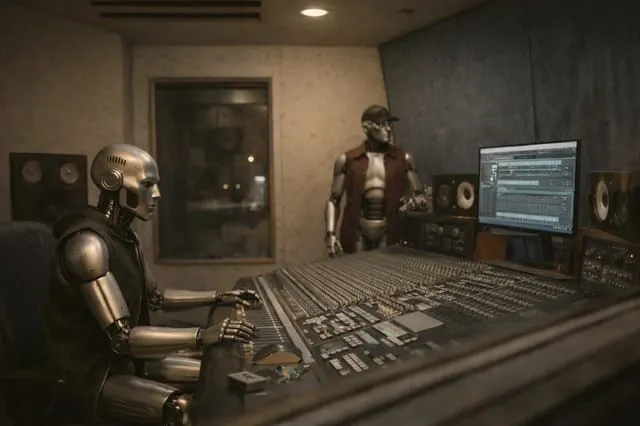
The music industry is deep in its AI era. Every panel, every post, every conversation is circling the same question: what happens when AI can make music?
Meanwhile, Suno just raised $250 million at a $2.45 billion valuation, crossed millions of paying users, and built a $300 million business while being sued by the very industry it’s disrupting.
So yes, AI in music is real. The demos are impressive, the legal implications are massive, and the existential questions are endless. Should machines make art? Will AI replace musicians?
But while everyone is locked into that debate, something more practical is being ignored. Because it isn’t about whether AI can make music, we already know it can. The real question is what happens around the music itself.
An artist today isn’t just a song. It’s a brand, a business, a voice that extends beyond streaming platforms into culture, content, and direct relationships with fans. There’s a world that has to be built, managed, and executed around every release. And that world is where most things break down.
The Part We Need to Fix
The industry doesn’t struggle because of creativity, but because of coordination. Music gets made every day, great music. That has never been the bottleneck. The issue lies in what happens next. With over 100,000 tracks now uploaded to streaming platforms every single day, the sheer volume of releases has outpaced the infrastructure behind them.
The people responsible for making releases work are stretched thin. Managers, marketers, A&Rs, project managers; they’re all doing the heavy lifting behind every release, but are reliant on email threads, text messages, shared folders, and disconnected tools. They’re chasing down final files, rebuilding rollout plans from scratch, and constantly putting out fires. It’s high-pressure, detail-heavy work, and it’s where burnout shows up the fastest.
The people doing the most operational work are often the ones with the least leverage, the least visibility, and, in many cases, the least compensation. Everyone is working, but no one has full visibility. So things slip, deadlines move, assets get lost, decisions get delayed, and momentum (which is the only thing that really matters in a release) starts to break.
This is not a technology problem, it is an infrastructure problem.
Artists Can Win the Fight Against AI
If the goal is to protect artists, then the conversation needs to shift. Because artists are not just vulnerable to AI; they are vulnerable to poor execution. Research shows that 88% of tracks on streaming platforms receive fewer than 1,000 plays, simply because the release around it didn't connect.
Most artists don’t fall short because they were outperformed creatively, but because their releases were not executed at a high enough level. The strategy was unclear, the rollout was inconsistent, the team was not aligned, and the learnings from previous releases were never carried forward.
When it comes to music, to quote Lil Wayne on the Not Just Football podcast:
“I love it. I love that AI is what it is. I love to be able to stand right next to whoever AI is, he, she, they, whatever, or whatever AI is, stand right next to them and I’m still better.”
It’s not a question of talent. We have incredible artists producing incredible music. It is, however, about systems and the fragmented ecosystem that our industry is working in.
Where AI Actually Creates Value
So what if we start thinking about AI as an enabler, not a replacer. It has the potential to turn the music industry on its head, but not in the way most people are framing it. Even Sony Music seems to agree. Their first-ever AI investment wasn't in a music generator, it was $16 million into Vermillio, an operational platform for rights and royalties management.
The real opportunity lies not in trying to use it to generate the music and replace the art form; it’s in supporting the people responsible for bringing that music to market. AI can track patterns across releases and make them usable; it can organize timelines so teams are not operating reactively; it can surface insights that would otherwise be lost in conversations and files; and it can create a level of structure and visibility that most teams have never had.
It’s not a question of replacing creativity, but reinforcing execution, the place where most releases win or lose.
+Read more: "9 Non-Generative AI Tools Artists Can Use to Get More S#*t Done in 2026"
What This Shift Looks Like
I think it’s fair to say most organizations have a skepticism around new technology, and rightly so. There are more and more tools flooding the market, making it hard to know where to invest for the long term.
But this is about more than adding more tools to your tech stack. If we’re to see the transformation we need, we need to think less about individual platforms, and more about replacing fragmentation with structure. In practice, that means creating a centralized ecosystem where releases are planned from start to finish, there’s clear ownership across individuals and teams so nothing falls into ambiguity, strategies can evolve based on performance instead of resetting every cycle, and data compounds over time instead of disappearing after each release.
Most teams are lacking a system that does just that, compounding and memorizing their hours of effort rather than wasting it.
The Real Competitive Advantage
It all boils down to continuity.
Every release starts from zero, every team builds their own version of a process, and every lesson gets lost before it can be applied again. That might have worked in slower eras of the past, but it doesn’t work in one where speed, precision, and iteration define success.
AI is accelerating everything already, it’s inescapable. Now the question is whether the industry itself can keep up. Because the real competitive advantage moving forward will be beyond creativity alone; coordination, clarity, and the ability to build momentum and not lose it are what will turn a masterpiece into a master success.
What Actually Needs to Change
AI is already having a meaningful impact on music, good and bad. But its value isn’t going to come from replacing artists. It will come from forcing the industry to modernize how it operates. Less focus on whether AI should make music, more focus on whether the systems around artists actually work.
Until that changes, the biggest risk to artists is not AI, but is everything surrounding how their music gets brought to the world.
Kedar Frederic is co-founder and CEO of Team, a release management platform built for labels, managers, and artist teams. Before building Team, Kedar spent a decade in the independent music ecosystem: founding a music tech startup that was acquired by TuneCore, leading artist relations and A&R across TuneCore and Believe, and working with independent artists and teams going from the majors to independent.