



By Stevan Pasero, Founder/CEO of Sugo Music Group
For independent artists, choosing a music distributor can look like a simple comparison of prices and percentages. One distributor charges an annual fee while allowing artists to retain 100% of their standard distribution royalties. Another charges no upfront distribution fee but receives a percentage of the revenue the music generates. Others combine elements of both approaches.
But those headline numbers don't necessarily tell you what distribution will actually cost — or which arrangement makes the most sense for your career. The goal is ultimately to understand: “What am I paying, what am I receiving in return, and how will those economics change as my catalog and revenue grow?”
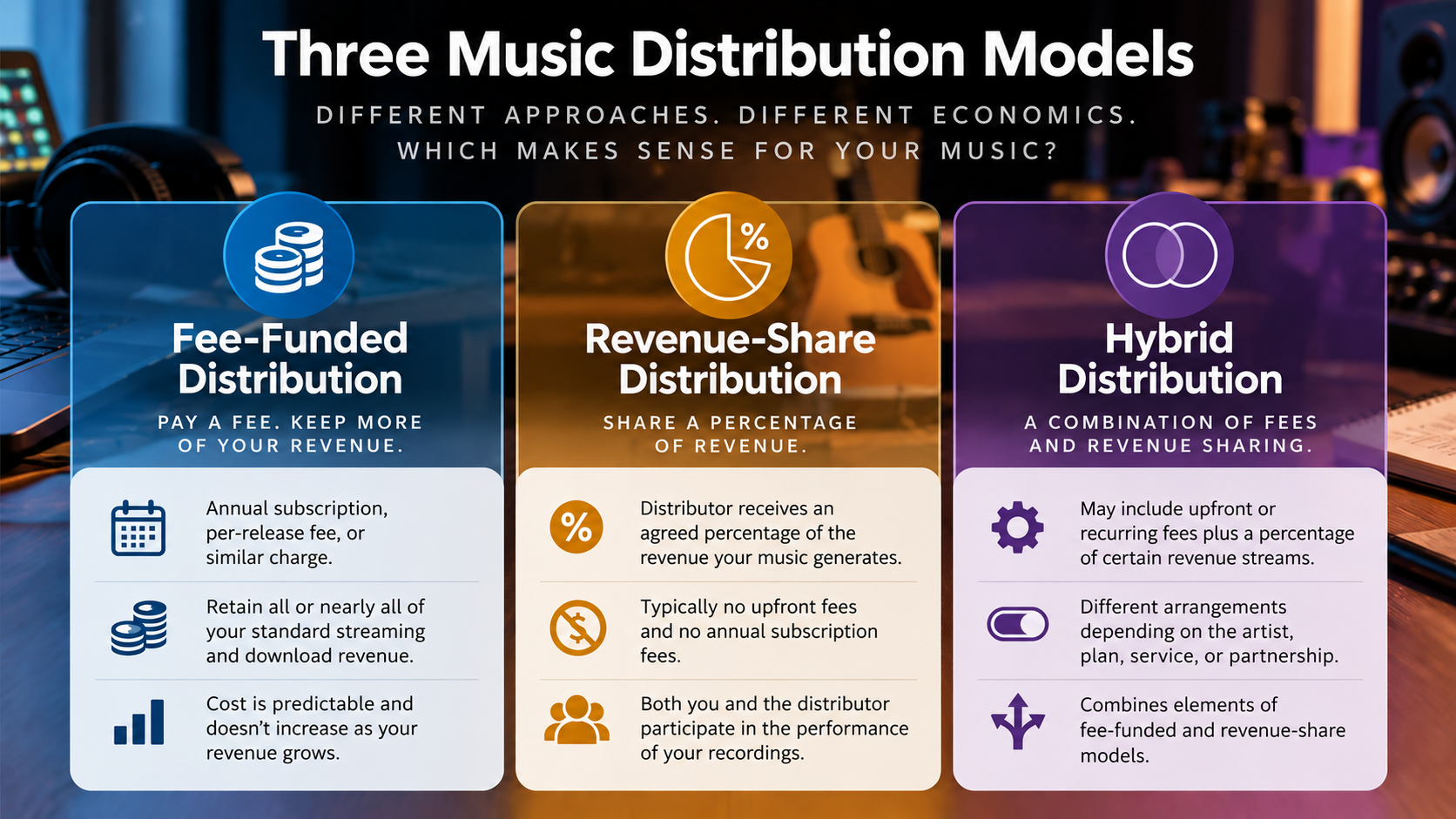
Understanding the three basic economic models of music distribution is a good place to start.
1. Fee-Funded Distribution
Under a fee-funded model, the artist or label pays the distributor directly, typically through an annual subscription, per-release fee, or similar charge.
Companies such as DistroKid, TuneCore, Ditto Music, and Amuse offer variations of this approach. Depending on the distributor and plan, artists may pay a recurring fee while retaining all or nearly all of their standard streaming and download revenue.
The appeal is easy to understand. Once the distribution fee has been paid, increasing streaming revenue doesn't necessarily mean paying the distributor a larger percentage of those earnings. But artists should look beyond the advertised subscription price.
This is particularly important for artists who release music frequently. An artist planning a series of singles throughout the year may incur multiple submission or release costs under certain pricing structures, along with recurring account or subscription fees. If those singles are later combined and released as an EP or album, the economics should be evaluated across the entire release strategy — not simply the cost of distributing one release.
Before choosing a distributor, estimate how many singles, EPs, and albums you expect to release during the year and calculate the total cost accordingly. Also ask whether the fee covers one artist or several, unlimited releases or a limited number, and which services are included.
For an artist releasing frequently or generating substantial revenue, a fixed-fee structure may be economically attractive. For an artist generating modest revenue, however, the fee remains an expense regardless of how the music performs.
2. Revenue-Share Distribution
Instead of relying primarily on an upfront or annual distribution fee, a revenue-share distributor receives an agreed percentage of the revenue generated by the recordings.
AWAL and ONErpm are examples of distributors using revenue participation in their distribution economics. Sugo Music Group, the company I founded, also operates under a revenue-share distribution model.
The basic economic distinction is important: the cost generally rises and falls with the revenue generated by the catalog. When a recording generates modest revenue, the distributor's share is correspondingly modest. As revenue grows, both the artist's earnings and the distributor's share increase.
Instead of the artist paying simply to gain access to distribution, both parties participate economically in the performance of the recordings. That doesn't automatically make revenue sharing better (or cheaper). For a high-earning artist, giving up a percentage of revenue may eventually cost considerably more than paying a fixed annual fee.
The important question is what the distributor provides in return for that participation.
3. Hybrid Distribution
Some distributors use hybrid models, combining fees and revenue participation or offering different arrangements depending on the artist, plan, service, or partnership.
CD Baby, Symphonic Distribution, and UnitedMasters illustrate variations of this broader category. An artist might encounter an upfront or recurring charge combined with commissions on particular revenue streams. Another distributor may offer a subscription plan for some artists while operating selective revenue-share partnerships for others.
This is why simply asking whether a distributor “charges a fee” can be misleading. You need to understand the entire arrangement.
Who Carries the Financial Risk?
One useful way to compare distribution models is to ask who pays before the music earns money.
- Under a fee-funded structure, the artist generally commits money to distribution regardless of how the release performs. The artist assumes that initial financial risk in exchange for retaining more of the revenue if the music succeeds.
- Under a revenue-share model, there may be little or no upfront distribution cost, but the distributor participates in the revenue if the recordings earn money.
- Hybrid arrangements can distribute that risk somewhere between the two.
For an established artist with predictable streaming revenue, paying a fixed fee may make financial sense. For a developing artist or a label managing a catalog with uncertain performance, avoiding recurring costs may have different advantages.
Neither structure is inherently right for everyone.
There Is No Universal Break-Even Point
Artists sometimes try to determine the exact revenue level at which a subscription becomes more economical than a percentage-based arrangement. That's a useful exercise — but there is no universal answer.
The calculation depends on the agreements being compared: subscription costs, release fees, revenue percentages, number of artists and releases, optional charges, included services, and other contractual terms.
Catalog size and release frequency matter too. An artist releasing numerous singles — or a label managing dozens of artists, releases, or catalog assets — can face very different economics depending on how the distributor structures its plans and charges. Likewise, a revenue percentage that seems inexpensive when a catalog generates modest income can become a significant expense as revenue increases.
Run the numbers using your own catalog, release schedule, and realistic revenue expectations.

+Read more: "The Modern Guide to Getting Your Music Played on Radio"
Distribution Is More Than Uploading Music
Price comparisons become more difficult because not all distribution services are alike. Virtually every distributor can deliver recordings to major streaming platforms. The differences often emerge in what happens before and after delivery.
Depending on the company and agreement, services may include:
- Metadata review and quality control
- Artwork review and DSP compliance
- Royalty accounting and reporting
- YouTube Content ID
- Social-platform monetization
- Release scheduling
- Artist and collaborator splits
- Catalog management
- Rights administration
- Cover-song licensing assistance
- Publishing administration
- Customer or account support
- Marketing and promotional tools
- Analytics
- Licensing or neighboring-rights services
Some of these may be included. Others may cost extra or may not be provided at all. An artist comparing distribution offers should therefore avoid treating distribution as a commodity where the only meaningful difference is the headline price.
A less expensive plan isn't necessarily less expensive if you need to purchase important services separately — or spend significant time handling them yourself.
Don't Forget About Publishing
For artists who also write their own songs, there is another important consideration: music publishing. Distribution and publishing administer different rights. Music distribution primarily concerns the sound recording, while music publishing concerns the underlying musical composition — the song itself.
Some music distributors or affiliated companies also offer publishing administration services that may include registering compositions with collection societies around the world and helping collect eligible mechanical and performance royalties.
These services may be included in a broader relationship, offered separately, or subject to additional fees or commissions.
For artists who write or control their songs, this can affect the overall value of a distribution relationship. A distributor that also provides publishing administration may offer a different level of service than a distribution-only company — but artists should understand what is included, what rights are being administered, and what the service costs.
This is another reason that comparing distributors solely by a subscription fee or royalty percentage may not provide the full picture.

+Read more: "The Spotify Paradox: More Powerful, Impossible to Leave"
Nine Questions to Ask Before Choosing a Distributor
Before signing up or moving your catalog, look beyond “100% royalties” or “no upfront fees” and ask:
- 1) What will I actually pay each year? Include subscriptions, per-release charges, additional-artist fees, optional services, and other applicable charges.
- 2) Does the distributor participate in my revenue? If so, determine which revenue streams are covered and what percentage applies.
- 3) What services are included? Compare the actual service package rather than assuming every distributor provides the same level of support.
- 4) What happens as my catalog grows? A model that works well for three releases may look very different when you're managing 30 or 300.
- 5) What happens if my revenue grows significantly? Calculate how fixed fees and revenue percentages would affect you at several realistic revenue levels.
- 6) What are the contract and exit terms? Understand exclusivity, term length, renewal provisions, takedown procedures, rights granted, and what happens when the relationship ends.
- 7) How does my release strategy affect the cost? If you plan to release multiple singles throughout the year — and perhaps later combine those songs into an EP or album — calculate the cost of your complete release schedule rather than a single release.
- 8) Do I also need publishing administration? If you write or control your compositions, determine whether the company offers publishing administration, global song registrations, and collection of eligible publishing royalties, and whether those services involve separate fees or commissions.
- 9) What do I actually need from a distributor? A self-sufficient artist who wants basic delivery may value a different model than an artist or label seeking hands-on catalog support, publishing administration, rights management, or additional services.
Don't Choose a Distributor by One Number
Independent artists have more distribution choices than ever, but that also means more business models to evaluate. A distributor that allows artists to retain 100% of their standard distribution royalties may still charge fees. A distributor charging no upfront fee may participate in revenue. A hybrid distributor may do both under different circumstances.
The goal is to understand the total economics of the relationship.
Before choosing a distributor, calculate the likely cost using your own catalog and release schedule, identify which services you need, consider whether you also need publishing administration, read the agreement, and think about how the economics could change as your career grows.
The most useful question to ask should always be:
“Which distribution relationship gives me the right combination of cost, services, support, and value for where my music career is today — and where I want it to go?”
Stevan Pasero is the Founder and CEO of Sugo Music Group and has worked in the music industry for 50 years as a music distribution and publishing executive, recording artist, producer, composer, and author. He is the author of Musical Darwinism: The Past Is the Portal to the Future of Music and contributes to the Sugo Music Group Music Knowledge Center.