

Live music has never been more... "visible." But it's not as romantic as you might think. Every night, thousands of performances are reduced to six-inch vertical videos: a chorus, a crowd reaction, a shaky glimpse of an artist through somebody else’s phone. Some hashtag you've never heard of.
Shareable digital content has flattened the live stage, and reduced its immersive magic into a data object.
But... it seems that there's still hope. At least the reigns of this problem are being taken up by two of today's most passionate cinema auteurs.
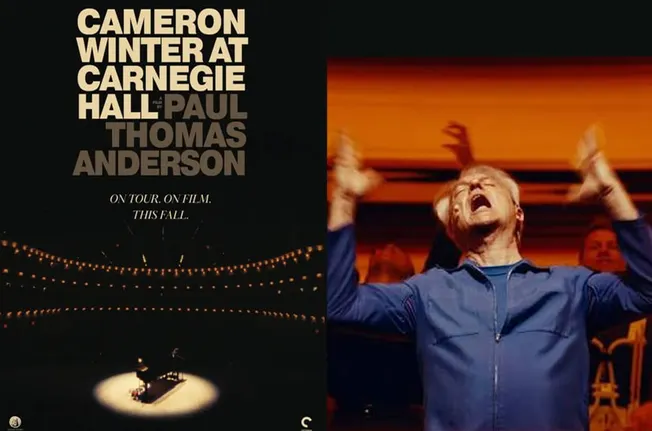
Paul Thomas Anderson’s Cameron Winter at Carnegie Hall, which captures Geese's singer/songwriter Cameron Winter live on 16mm and 35mm, is headed to theaters through Janus Films and Criterion. And, just recently, David Byrne revealed that The Brutalist director Brady Corbet had captured his elaborate Who Is the Sky? tour in 70mm.
Not livestreamed. Not optimized for social media. Not chopped into “content.” Celluloid. Movie theaters. The biggest possible image.
The stage is moving, people.
A Concert Film That Will Literally Tour
Cameron Winter at Carnegie Hall documents the Geese frontman’s sold-out solo performance at the New York institution in December 2025. Winter accompanied himself on a Steinway grand piano, giving Anderson an unusually stripped-down performance to place inside one of the world’s most imposing concert spaces.
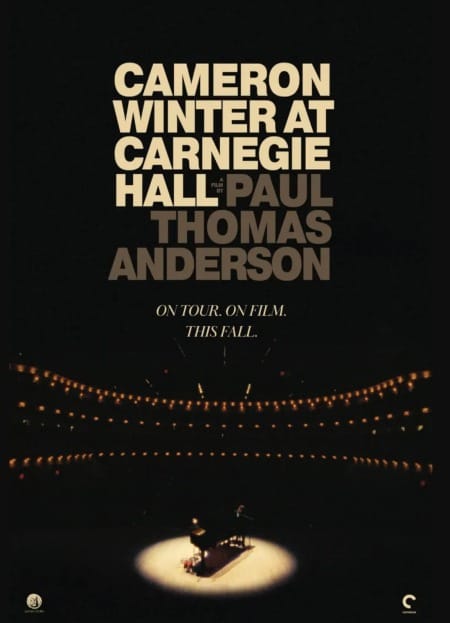
Anderson directed and shot the 75-minute film with a crew that included filmmaker Benny Safdie, while producer Ariel Rechtshaid recorded the music. The result will have its world premiere at the New York Film Festival on October 1, with Anderson and Winter attending. Film at Lincoln Center describes the film as balancing intimate images of Winter with the scale of Carnegie Hall itself"
"The result is a smashing cinematic concert, shot on 16mm and 35mm with a perfect mix of intimate images of Winter and of the cavernous space, keyed into the singer-songwriter’s effortless combination of bravado and sensitivity, darkness and light."
Then the movie will effectively go on tour. Beginning November 20, supervised 35mm prints made by FotoKem will travel through North American theaters, and the schedule currently extends through January 18. Janus and Criterion’s theatrical rollout makes the format part of the attraction: audiences are not simply seeing footage of the concert. They are seeing an actual film print.
+Read more: "The Story of “That” Rooftop Concert"
David Byrne Goes Even Bigger
Brady Corbet’s untitled film of David Byrne’s Who Is the Sky? tour takes the idea further. It was captured over multiple performances in Byrne’s hometown of Baltimore using both 8-perf and 15-perf 70mm formats.
.jpeg)
Byrne’s show features 13 musicians, singers, and dancers moving across the stage, blending music, choreography, visual art, and storytelling. According to Byrne, he did not initially understand how dramatically 70mm would change the presentation until Corbet sent him early frames. It captured the show’s widescreen scale in a way he had never seen before. Release and distribution details have not yet been announced.
Of course, Byrne understands better than most that a concert film can become its own work of art. Jonathan Demme’s Stop Making Sense did not merely preserve a Talking Heads performance; it used framing, pacing, choreography and gradual accumulation to reinvent it for cinema. Spike Lee later interpreted Byrne’s Broadway production American Utopia for the screen.
Corbet now becomes the latest major filmmaker to look at Byrne’s stage work and see material for a movie — not merely documentation.
+Read more: "Amyl & The Sniffers: How a F*ing Good Concert Film Helps You Grow"
Concert Films Used to Be Movies. No, Like, REAL Movies!
There is a rich precedent for that approach. Any music fan would be familiar with how D.A. Pennebaker’s Monterey Pop transformed the 1967 festival into vivid cultural history. Albert and David Maysles and Charlotte Zwerin’s Gimme Shelter began as a Rolling Stones tour film and became a disquieting portrait of the disastrous 1969 Altamont concert.
Adrian Maben’s Pink Floyd: Live at Pompeii removed the audience altogether, placing the band inside an ancient Roman amphitheater and turning a performance into something closer to science fiction.
For The Last Waltz, Martin Scorsese approached The Band’s 1976 farewell concert as a full-scale cinematic production, using seven 35mm cameras, carefully planned coverage and renowned cinematographers. The resulting 1978 film remains as much a Scorsese movie as it is a record of The Band. Criterion calls it:
"An at once ecstatic and elegiac summation of a vital era in American rock music."
These films did not ask how closely a camera could reproduce the experience of standing in the room. They asked what cinema itself could reveal about a live performance that the room could not, what stories could be told when the live stage becomes both a setting and a plot point.
So, Why Is This Artistic Form Returning Now?
The timing of these new projects is a bit counterintuitive, and that might shed some light as to exactly what's prompting the reemergence of the form.
Firstly, the live business has been experiencing enormous demand for several years, with global attendance at Live Nation concerts reaching 159 million in 2025. Movie theaters have had a slower and more uneven recovery in the last decade, but the momentum is becoming harder to ignore. The summer 2026 domestic box office reached approximately $4.6 billion, its strongest summer since the pandemic, with younger moviegoers helping drive the rebound.
Audiences have clearly showed that they will leave home when a screening feels like an occasion. And this is where the concert film suddenly becomes especially powerful.
In terms of "in person" entertainment, two communal rituals are collapsing into one. People gather in a music venue to experience the shared embodied immersiveness of an original performance, and the same transformative experience in the cinema.
On a second level, because of social media and the scalability of digital content marketing, so much of today’s live-performance footage is used primarily for immediacy: record a full show, cut it into digestible clips, get those clip online, catch the algorithm, and keep the tour visible.
But speed and volume are not the only ways to extend the life of a show. And audiences that truly care about witnessing their favorite bands and artists in an elevated experiential environment are not satisfied by the reduction in quality of watching live music on their phones.
New questions for musical artists are being opened up when it comes to documenting and capturing live performance:
- What does the room communicate?
- Where could cameras be, or be hidden?
- What story does the lighting tell?
- Should the film make viewers feel like audience members — or show them something the audience could never have seen?
- What happens the day of a show, or the night that follows it?
These top-end auteur cinema projects suggest that the concert film can be so much more. And I'm personally super excited to watch both these films, and to watch this art form grow and expand in years to come.