

Alaska’s music fans apparently like their riffs as extreme as their weather. A new analysis of Google Trends data found that metal is Alaska’s most disproportionately searched music genre, placing the state inside one of the study’s biggest (and least predictable) national music blocs.
Ticket search platform SeatPick examined state-level interest in 18 genres over the 12 months ending August 11, 2026. The categories included pop, country, hip hop, rock, metal, R&B, soul, jazz, punk, reggae, EDM, Latin, indie, folk, gospel, blues, bluegrass, and classical music.
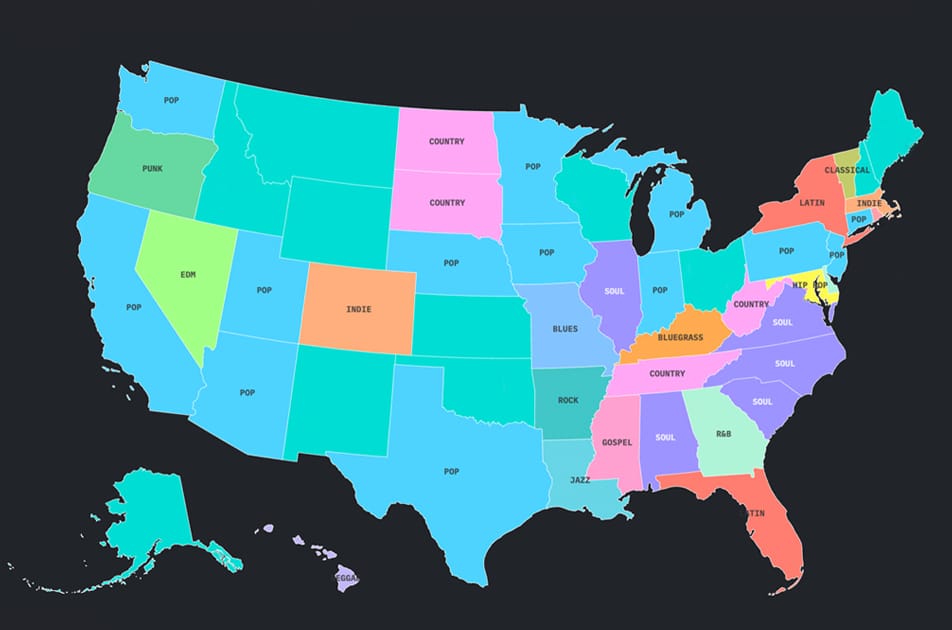
Pop finished first overall, indexing highest in 13 states. But metal was close behind, taking the top position in 11 — including Alaska, Wyoming, Montana, Maine and New Hampshire. Apparently, cold weather and loud guitars travel together.
Pop Wins America — But Barely
Pop’s 13-state victory stretched from California and Washington to Texas and Arizona, making it the closest thing the study found to a national consensus.
Metal’s second-place finish may be the more interesting result, however. It suggests that the genre’s audience is not concentrated solely in the industrial cities or established regional scenes commonly associated with heavy music. Its strongest relative search interest appears across a large collection of central, northern and remote states.
Soul ranked third, leading in Alabama, North Carolina, South Carolina, Virginia and Illinois. Country — often treated as the default soundtrack of a huge portion of the country — finished first in only four states: Tennessee, West Virginia, North Dakota and South Dakota.
In other words, most of the South did not choose country music.
Indie led in Colorado, Massachusetts and Rhode Island, while Latin and R&B each topped two states. Eleven other genres—including jazz, blues, gospel, punk, reggae, bluegrass, folk, hip hop, rock, EDM and classical—managed at least one state.
Among the map’s other delightful outliers: Arkansas indexed highest for rock, while Vermont chose classical music. The complete results can be explored through SeatPick’s interactive map of America’s music searches.
+Read more: "What's Changed for Indie Band Tours Since COVID? Remarkably Little..."
What “Most-Searched” Actually Means
There is an important caveat here: the study does not measure total listening, record sales, concert attendance or even the raw number of searches conducted inside each state. Google Trends scores show where a term attracts unusually strong interest relative to other locations. SeatPick measured each genre separately and then assigned every state the genre for which it indexed highest.
That means metal did not necessarily generate more searches in Alaska than pop did. Instead, Alaskans searched for metal more intensely relative to the rest of America than they did for the other genres studied. So this is better understood as a map of regional musical affinity, not a definitive ranking of what every resident is streaming.
Why Artists Should Care
For independent artists, we're not sure there's an enormously actionable takeaway in this study. However, as national streaming totals do tend to favor the same enormous genres and artists everywhere, relative search interest can reveal pockets of demand that disappear inside those national averages.
For example, if you're a metal band considering a northern routing strategy, an indie act buying regional ads, or a promoter testing an unfamiliar market, you may be inclined to rely on data like this to assume where concentrated interest in your genre might power attendance and attention.
Search activity cannot guarantee ticket sales, of course. But it can identify places where a genre occupies more cultural space than conventional wisdom suggests. And somewhere under the northern lights, Alaska is apparently turning the volume all the way up.
+Read more: "What Makes China's Music Market So Different?"